Where Safety Meets Expert Tree Service.

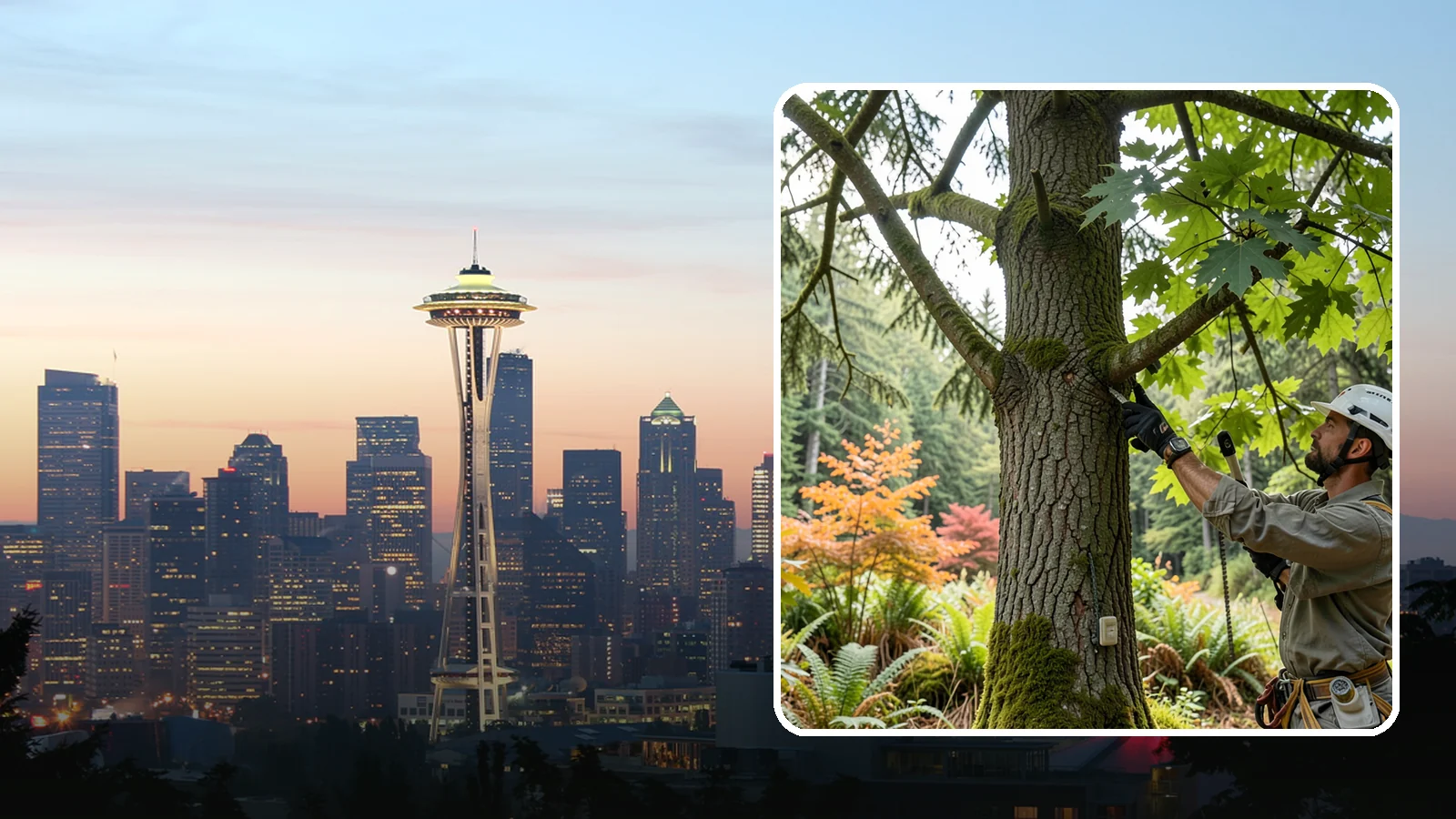
Seattle Tree Health Inspection
A professional evaluation of a tree’s overall condition.
About 82% of Seattle's yearly rain and snow falls between October and April, according to Daymet data for 2005 to 2025. That makes late summer and early fall a practical time to have a tree looked at, before the wet months arrive and saturated soil adds stress to a tree that is already struggling.
A tree health inspection is a close, ground-level check of the roots, trunk, and canopy. It aims to find problems early, such as dieback, decay, or structural defects, so you can decide what to do while you still have options.
About Tree Health Inspection in Seattle
A tree health inspection offers a professional look at your trees’ overall condition to help keep them safe and strong for years to come. This valuable check-up is designed specifically for homeowners who want to catch potential issues before they become serious problems. It serves as the first step in creating a customized care plan that supports long-term stability and life extension for valued specimens.
What Seattle Tree Health Inspection Includes
Tree health inspection provides an expert evaluation of your trees’ current status, focusing on identifying early warning signs of trouble. Our trained crews follow recognized arboricultural standards to assess soil quality, root structure, pest presence, and disease indicators while matching methods to each tree’s specific species and site conditions. The goal is to clearly identify contributing factors like compacted soils or girdling roots so you can guide an effective care plan forward.
Seattle Tree Health Inspection Process
Our team begins by carefully inspecting the tree within its surrounding environment to understand how soil, pests, or past construction might be affecting it. Once we have identified these issues, we recommend and apply appropriate treatments while documenting our findings for your records. We ensure that follow-up care is planned based on accurate documentation of conditions found during the initial visit.
Equipment We Use for Seattle Tree Health Inspection
To get a complete picture, we utilize diagnostic tools along with soil probes and sampling kits to examine what lies beneath the surface. Depending on access needs or wet season conditions, our crews may bring air excavation tools to gently assess root zones without causing damage. We also use specialized injection equipment for treatments while wearing necessary personal protective gear throughout the workday.
Seattle Tree Health Inspection Safety & Best Practices
During any inspection involving products, we strictly follow label instructions and application guidelines to ensure everyone remains safe. Our methods are designed to protect your soil and surrounding plantings while avoiding accidental damage to roots or trunks during our visit. We take great care to document all conditions accurately so that future treatments remain effective without risking the tree’s health.
Signs You Need Tree Health Inspection in Seattle
You may need this service if you notice signs of decline caused by poor soils, pests, disease, or changes in ground grade from past construction. Girdling roots and other hidden issues often go unnoticed until a professional evaluation reveals them early enough to prevent escalation. If your trees have experienced stress from environmental shifts or nearby development, an inspection can help determine the best path forward for their recovery.
What Affects the Cost of Tree Health Inspection in Seattle
The investment for this service varies based on several factors including the specific species of tree being evaluated and the complexity of diagnosing soil issues. Site conditions such as difficult access requirements will also influence how much time and resources are needed to complete a thorough assessment. Additionally, identifying pests or diseases requires specialized attention that impacts the overall cost structure of your care plan.
Best Time of Year for Seattle Tree Health Inspection
In our Puget Sound climate, you can schedule this inspection at any point throughout the year since trees remain active in most seasons. However, during wetter periods, we may need to use air excavation tools specifically to effectively assess root zones without getting bogged down by mud or water. Planning your visit allows us to choose the right timing and equipment for clear results regardless of current weather patterns.

How a tree health inspection works in Seattle
An inspection follows a set order. We start at the base and work upward.
- Root flare and soil: we look for soil heaving, fungal growth, cut or buried roots, and compacted ground.
- Trunk: we check for cracks, cavities, bark damage, and lean. Trunk shape matters too. WSU Extension's Pacific Northwest Gardener's Handbook lists a lack of trunk taper, or reverse taper at ground level, as a defect.
- Canopy: we look for thinning leaves, dead branches, poor leaf color, and weak branch unions.
Then we explain what we found and what it could mean. Some trees only need monitoring. Others may need pruning, treatment, or removal. We check with the city before any removal work starts, because Seattle has its own tree rules.
What the local data can and cannot tell you
A 2021 to 2025 aerial survey by the USDA Forest Service and Washington DNR mapped damage in forest within 10 km of Seattle. It covers forest land, not street or yard trees, so it does not describe your tree. Still, it shows what is being seen nearby. The largest category was decline with no cause identified, at 4,629 acres, mostly Pacific madrone, bigleaf maple, and unknown hardwoods. That label means dieback where no single cause was found. The same survey mapped bears damage on 190 acres of Douglas-fir and Douglas-fir engraver on 114 acres of Douglas-fir.
If you have a madrone, a bigleaf maple, or a Douglas-fir, that is a good reason to look closely at the canopy for thinning or dieback. Seattle sits in USDA hardiness zone 9a, with parts of the city in 9b. That range is mild, so cold damage is rarely the first suspect when a tree looks off.
To schedule an inspection, call or text 425-484-4442. Our ISA Certified Arborist can walk the property with you, and estimates are free.
Seattle tree conditions at a glance
| USDA hardiness zone | 9a (9a to 9b across the city) |
|---|---|
| Rain and snow falling October to April | 82% of the year’s total |
| Days with 0.1 in or more of rain | 98 a year |
| Tree canopy | 28.0% of the city (city assessment, 2021) |
| Days that freeze at night and thaw by day | 27 a year |
Most common street trees in Seattle
- (Smooth) Japanese Maple3.6%
- Bigleaf Maple2.9%
- Red Maple2.8%
- Apple/Crabapple2.5%
- Norway Maple2.5%
- Cherry/Plum/Laurel2.3%
Share of 240,243 trees in the city’s street-tree inventory; median trunk diameter 8.0 in, 8.0% at 24 in or wider.
Tree health near Seattle
Spongy moth (WSDA 2025): WSDA trap detection(s): 1 moth(s) in 1 trap catch record(s).
Spongy moth (WSDA 2022): WSDA trap detection(s): 1 catch record(s) listed (per-trap counts not given).
- Decline, cause not identified4,629 ac
- Bears190 ac
- Douglas-fir engraver114 ac
Forest damage mapped from the air within 10 km of Seattle, 2021-2025 (USDA Forest Service and WA DNR). This covers forest land, not street or yard trees. “Decline, cause not identified” is dieback with no single cause found.
Sources: Daymet daily weather (NASA/ORNL), NOAA Storm Events, USDA plant hardiness map 2023, NRCS soil survey, USGS elevation, WA DNR landslide inventory, USDA Forest Service aerial survey, WSDA, city tree assessments and street-tree inventories, SILVIS Lab, Arbor Day Foundation, and official city and utility pages.
Tree Health Inspection Serving Seattle
Seattle

Tree health inspection in nearby areas
Also serving Seattle
- Tree Staking in Seattleat Washington Landscaping
- Irrigation Repair in Seattleat Washington City Services