Where Safety Meets Expert Tree Service.

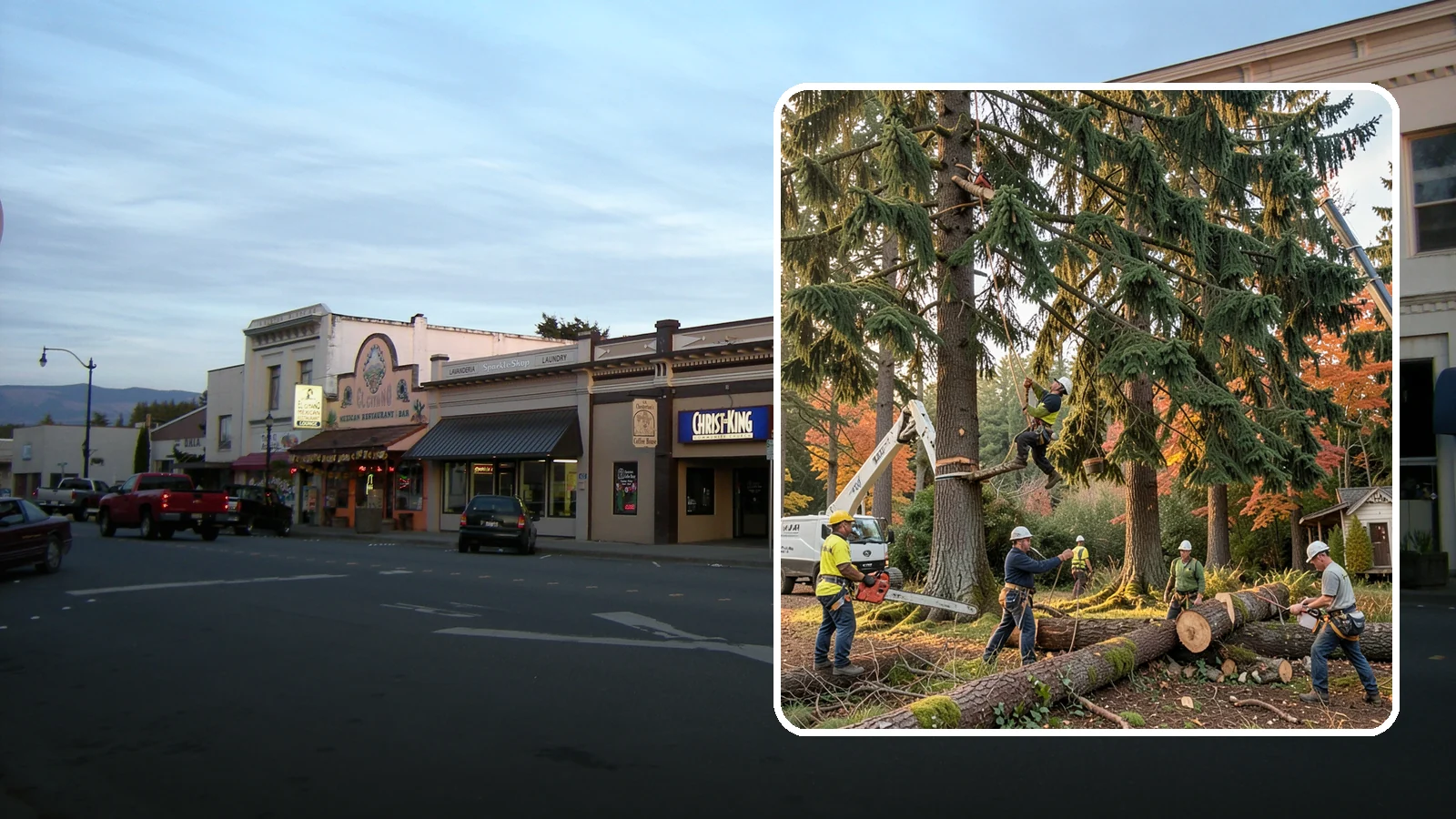
Burlington Multi-tree Removal
The coordinated removal of several trees in a single project.
Should you remove several trees at once or spread the work out? If the trees share a problem, such as crowding, decline, or a spot where a future building or driveway is planned, one planned job is usually simpler. If only one or two are a concern, remove those and reassess the rest later.
Walk the site first. Note which trees lean, have dead tops, or sit close to structures and lines. Photograph them and mark the ones you want gone. That gives a clear starting point for a removal plan.
About Multi-tree Removal in Burlington
If you have a cluster of trees on your property that need attention at once, our multi-tree removal service is designed for homeowners facing larger projects like site preparation or safety clearance. Our trained crews work together to handle these groups efficiently while keeping your home and family safe throughout the process.
What Burlington Multi-tree Removal Includes
This coordinated approach allows us to remove several trees in a single project rather than tackling them one by one over multiple visits. We use methods that match each tree species, site conditions, and access points to ensure a smooth operation for clearing groups of trees due to safety or health concerns.
Burlington Multi-tree Removal Process
The work begins with an on-site assessment where we evaluate hazards and establish clear drop zones before any cutting starts. Our crew will then rig limbs or fell stems in a controlled sequence using proper communication between climbers and ground workers, followed by processing the wood and clearing all debris from your yard.
Equipment We Use for Burlington Multi-tree Removal
We bring professional tools to every job site, including chainsaws for precise cuts and powerful chippers to process branches into mulch. Depending on the specific needs of your property, we may also utilize aerial lifts or cranes along with climbing gear and ground protection mats to keep surfaces safe during removal.
Burlington Multi-tree Removal Safety & Best Practices
Safety is our top priority, so we always identify overhead utility lines before starting and inspect every tree for hidden decay or structural defects. Our team maintains strict control over fall paths and drop zones while using personal protective equipment and coordinated communication to prevent accidents around your home.
Signs You Need Multi-tree Removal in Burlington
You might need this service if you notice safety hazards forming in a group of trees, disease spreading between them, or simply want to free up usable space on your land. Situations such as limited access for standard equipment or unpredictable lean patterns often require our specialized multi-tree removal expertise to manage safely.
What Affects the Cost of Multi-tree Removal in Burlington
The investment for removing multiple trees is influenced by how difficult it is to reach the site and whether nearby structures or power lines complicate the work. Additional factors include the complexity required to safely manage drop zones during coordinated felling sequences, which ensures everyone stays protected while we complete the job.
Best Time of Year for Burlington Multi-tree Removal
In our local climate, this service can be performed year-round as long as ground conditions allow equipment mobility without damaging sensitive soil areas. We monitor weather and site stability closely to ensure that work proceeds smoothly regardless of the season, provided safety remains a priority for every step taken.

Removing several trees in Burlington: rules and planning
Check the city rule before you mark trees
Burlington's tree code, in Title 17 on the city's website, says significant trees may not be removed without prior authorization from the department. The regulated size is 6 inches DBH. For a multi-stem tree, it counts if any stem is at least 4 inches, measured 6 inches from the trunk joint. That matters on a multi-tree job because each tree gets measured, and the count adds up.
The same code says the significant-tree rules do not apply to trees within the boundaries of an existing landscaped yard associated with an individual dwelling, except in redevelopment projects. Whether a given tree falls inside that exception is not always obvious, especially near the edge of a lot or on land being redeveloped. The text we have is also cut off on the other exceptions. So we check with the city before work starts, and we suggest you do not cut anything until that is settled.
Replacement trees add up
Where the rules do apply, the city's code calls for 2 replacement trees for each removed tree 6 to 18 inches DBH, and 4 for each tree over 18 inches. With several trees coming out, that count can grow quickly. Plan planting space early, and ask the city about the minimum sizes it sets for replacements, such as for deciduous trees.
Sequence the work on the property
With a group of trees, the order of removal matters. Standard practice, in line with ANSI A300 and ISA guidance, is to look at each tree's lean, defects, and surroundings, and then plan where each one will fall or be lowered in sections. Trees that are close to buildings, fences, or each other are often taken down piece by piece instead of felled whole.
- Mark every tree you are considering, and measure the trunk at DBH.
- Note anything under or near the trees, such as structures, wires, or septic areas.
- Decide whether you want stumps ground out and what you plan to plant afterward.
Burlington sits in USDA hardiness zone 8b, according to the 2023 USDA map. That helps when you choose replacements, since species rated for that zone are the ones to look at first. A free estimate lets us walk the site with you and talk through the order of work.
Burlington tree conditions at a glance
| USDA hardiness zone | 8b |
|---|---|
| Slopes | Some steep slopes |
| Soils | 4% of land has hardpan or another restrictive layer within 40 in; most common series Field |
| High and strong wind episodes, 2005-2025 | 33 in the forecast zone |
| Electric utility | Puget Sound Energy (PSE) |
Tree removal rules in Burlington
Significant trees may not be removed without prior authorization from the department, BUT the significant-tree rules do not apply to trees within the boundaries of an existing landscaped yard associated with an individual dwelling (except redevelopment projects), nor to construction of a single detached dwelling, duplex or small multiunit building or land divisions of four lots or less. So ordinary removal in an existing single-family yard needs no tree approval outside critical areas.
Regulated size: 6 inches DBH (multi-stem: any stem at least 4 in. measured 6 in. from the trunk joint).
Official city source. Rules change; we confirm with the city before work starts.
Trees near the power line to your house
Puget Sound Energy (PSE): Service line (wire from PSE pole to home or meter pole): PSE does not trim it; homeowner/private arborist trims.
PSE performs a safety disconnection so the homeowner or private tree trimmer/arborist can work; Call at least 5 business days ahead to check crew availability and potential charges.
Safety disconnect: 1-888-321-7779 (5+ business days ahead). Utility page.
Any fee for a disconnect is set by the utility.
Strongest wind events near Burlington
- Dec 14, 2006: gusts to 85 mph
- Feb 3, 2006: gusts to 78 mph
- Nov 15, 2006: gusts to 74 mph
NOAA Storm Events, forecast zone that includes Burlington, 2005-2025.
Sources: Daymet daily weather (NASA/ORNL), NOAA Storm Events, USDA plant hardiness map 2023, NRCS soil survey, USGS elevation, WA DNR landslide inventory, USDA Forest Service aerial survey, WSDA, city tree assessments and street-tree inventories, SILVIS Lab, Arbor Day Foundation, and official city and utility pages.
Multi-tree Removal Serving Burlington
Burlington

Multi-tree removal in nearby areas
Also serving Burlington
- Ornamental Tree Planting in Burlingtonat Washington Landscaping
- Vegetation Management in Burlingtonat Washington City Services
- Firewood Processing in Burlingtonat Washington Firewood