Where Safety Meets Expert Tree Service.


Burlington HOA Tree Management
Coordinated tree management for homeowner associations.
A board member walks the common areas and sees a limb hanging over a walkway, a stand of conifers crowding a fence, or a row of trees that has never been pruned. Residents start sending emails. Nobody is sure who owns the problem or which trees are shared property.
HOA tree management starts with a walk-through and a written list of what each tree needs and in what order. That gives the board something concrete to budget, schedule and explain to homeowners.
About HOA Tree Management in Burlington
HOA tree management provides coordinated care for shared trees across a community, ensuring they remain safe and presentable for all residents. This service is designed specifically for homeowner associations that need consistent maintenance without the burden of individual scheduling or oversight. We work with trained crews to handle these communal assets using methods matched to each specific site condition.
What Burlington HOA Tree Management Includes
Our approach includes maintaining shared trees consistently while following recognized arboricultural standards throughout the entire community. Work plans are tailored to match tree species and local access challenges, ensuring every project fits its unique environment. This category of service focuses on property maintenance that keeps common areas looking their best year after year.
Burlington HOA Tree Management Process
The typical process begins with a thorough inventory and assessment of all trees within the association’s boundaries. We then develop a clear maintenance schedule and priorities based on those findings before performing recurring pruning, inspections, and care tasks. Throughout the project, we document our work to keep your plan updated as conditions change over time.
Equipment We Use for Burlington HOA Tree Management
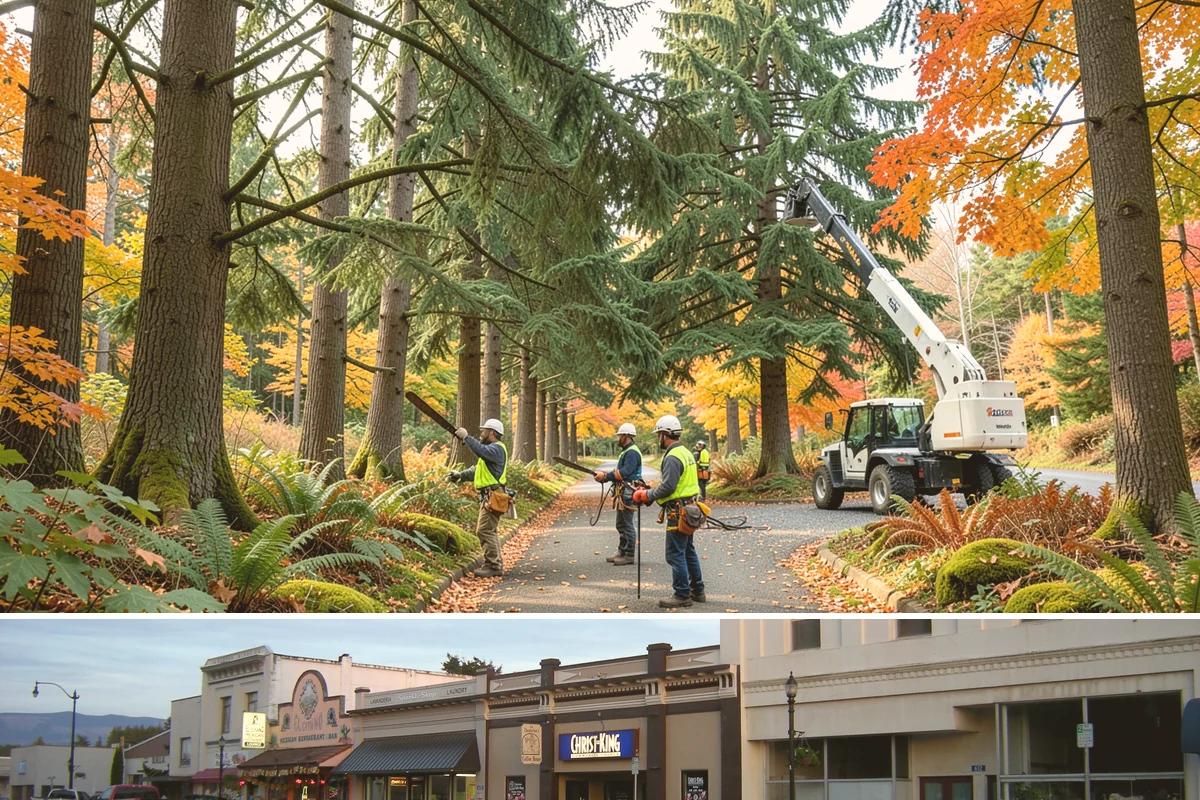
To complete these projects effectively, crews utilize specialized pruning and rigging gear along with aerial lifts when necessary for difficult-to-reach branches. Inspection tools help identify potential issues early, while chipper and hauling equipment manage debris efficiently on-site. All workers wear personal protective equipment to ensure a safe environment during every operation.
Burlington HOA Tree Management Safety & Best Practices
We coordinate all work carefully around occupied homes and active traffic flows to minimize disruption and risk. Maintaining strict safety zones in public areas is essential when managing trees near shared walkways or driveways. By following recognized standards and keeping detailed records, we hold ourselves accountable for the highest level of care at every step.
Signs You Need HOA Tree Management in Burlington
You may need this service if your association faces deferred maintenance backlogs that threaten tree health across multiple properties. High-traffic areas often require extra attention to prevent damage from falling limbs or roots encroaching on sidewalks and roads. Varied conditions within a single site can also indicate the need for a unified plan rather than ad-hoc repairs.
What Affects the Cost of HOA Tree Management in Burlington
Several factors influence the final cost, including any existing backlogs of deferred maintenance that must be addressed first. Areas with high foot traffic require careful coordination to protect people while working around busy shared spaces. The varied conditions found across different parts of your site and the complexity of scheduling access for multiple trees also play a role in pricing.
Best Time of Year for Burlington HOA Tree Management
Work is performed year-round, allowing us to address needs as they arise rather than waiting for a single optimal season. Our methods are matched to specific tree species and current site conditions so that care can happen whenever it is most beneficial. This flexibility ensures consistent maintenance regardless of the weather or time of year in Washington State.

How HOA tree management works in Burlington
Most tree problems in a community build slowly. Trees in common areas get planted together, grow together and are pruned late or not at all. Then one storm or one complaint forces a rush job. A survey of every common-area tree, done before that point, lets the board spread the work over time.
Standard practice here follows ISA and ANSI A300 pruning guidelines. An arborist looks at structure, dead wood, crossing branches, clearance over roofs, paths and parking, and signs of decay at the base. Each tree gets a plain recommendation: prune, monitor, or remove. We do not recommend topping, which weakens a tree and tends to create weak regrowth.
Burlington is in USDA hardiness zone 8b, according to the USDA map from 2023. That is a mild zone, and it supports a wide mix of species. For an HOA, this means a community may have several kinds of trees with different pruning needs and timing. A single schedule for every tree rarely fits.
The city rule matters for removals. Burlington's tree code, in Title 17, says significant trees may not be removed without prior authorization from the department. Regulated size starts at 6 inches DBH, or for multi-stem trees, any stem at least 4 inches measured 6 inches from the trunk joint. The same code says the significant-tree rules do not apply to trees within an existing landscaped yard associated with an individual dwelling, except in redevelopment projects. Whether a common-area tree counts as that kind of yard is not always clear. So before any removal, we check with the city. That rule is about removal, and we do not assume it covers or excuses other work.
About half of Burlington's housing is single-family detached houses, according to Census ACS 2020-2024. In a community like that, many trees sit right at the line between common land and a homeowner's lot. Boundaries and responsibility should be settled in writing before work begins, so neighbors are not surprised.
After the walk-through, the board gets a prioritized plan. Free estimates are available, and you can call or text 425-484-4442 to set up a visit.
Burlington tree conditions at a glance
| USDA hardiness zone | 8b |
|---|---|
| High and strong wind episodes, 2005-2025 | 33 in the forecast zone |
| Soils | 4% of land has hardpan or another restrictive layer within 40 in; most common series Field |
Tree removal rules in Burlington
Significant trees may not be removed without prior authorization from the department, BUT the significant-tree rules do not apply to trees within the boundaries of an existing landscaped yard associated with an individual dwelling (except redevelopment projects), nor to construction of a single detached dwelling, duplex or small multiunit building or land divisions of four lots or less. So ordinary removal in an existing single-family yard needs no tree approval outside critical areas.
Regulated size: 6 inches DBH (multi-stem: any stem at least 4 in. measured 6 in. from the trunk joint).
Official city source. Rules change; we confirm with the city before work starts.
Sources: Daymet daily weather (NASA/ORNL), NOAA Storm Events, USDA plant hardiness map 2023, NRCS soil survey, USGS elevation, WA DNR landslide inventory, USDA Forest Service aerial survey, WSDA, city tree assessments and street-tree inventories, SILVIS Lab, Arbor Day Foundation, and official city and utility pages.
HOA Tree Management Serving Burlington
Burlington

HOA tree management in nearby areas
Also serving Burlington
- Emergency Tree Response in Burlingtonat Washington City Services
- Monthly Landscape Maintenance in Burlingtonat Washington Landscaping
- Mixed-Use Construction in Burlingtonat Washington Construction
- Loading Dock Cleaning in Burlingtonat Washington Pressure Washing