Where Safety Meets Expert Tree Service.


Kenmore Privacy Screen Planting
The planting of trees to form a living screen.
Privacy screen planting suits Kenmore homeowners whose yard is overlooked by a neighbor's window, a new build next door, or a busy road. It also suits owners who want a living fence instead of boards, and who can wait a few seasons for it to fill in.
The right plan depends on how much room you have, how fast you need cover, and what the ground under the planting strip is like. Here is how the main approaches compare, and what Kenmore conditions mean for each.
About Privacy Screen Planting in Kenmore
We help homeowners create a natural barrier that brings peace and quiet back to their outdoor spaces. Our team specializes in planting trees specifically designed to form a living screen for your property. This approach restores tree cover while supporting the local ecology right where you live.
What Kenmore Privacy Screen Planting Includes
Privacy screen planting involves placing trees strategically to block views, reduce noise, and shield against wind. We match our methods carefully to the specific species chosen and the unique conditions of your site. The goal is to establish a healthy, durable living wall that grows with your needs over time.
Kenmore Privacy Screen Planting Process
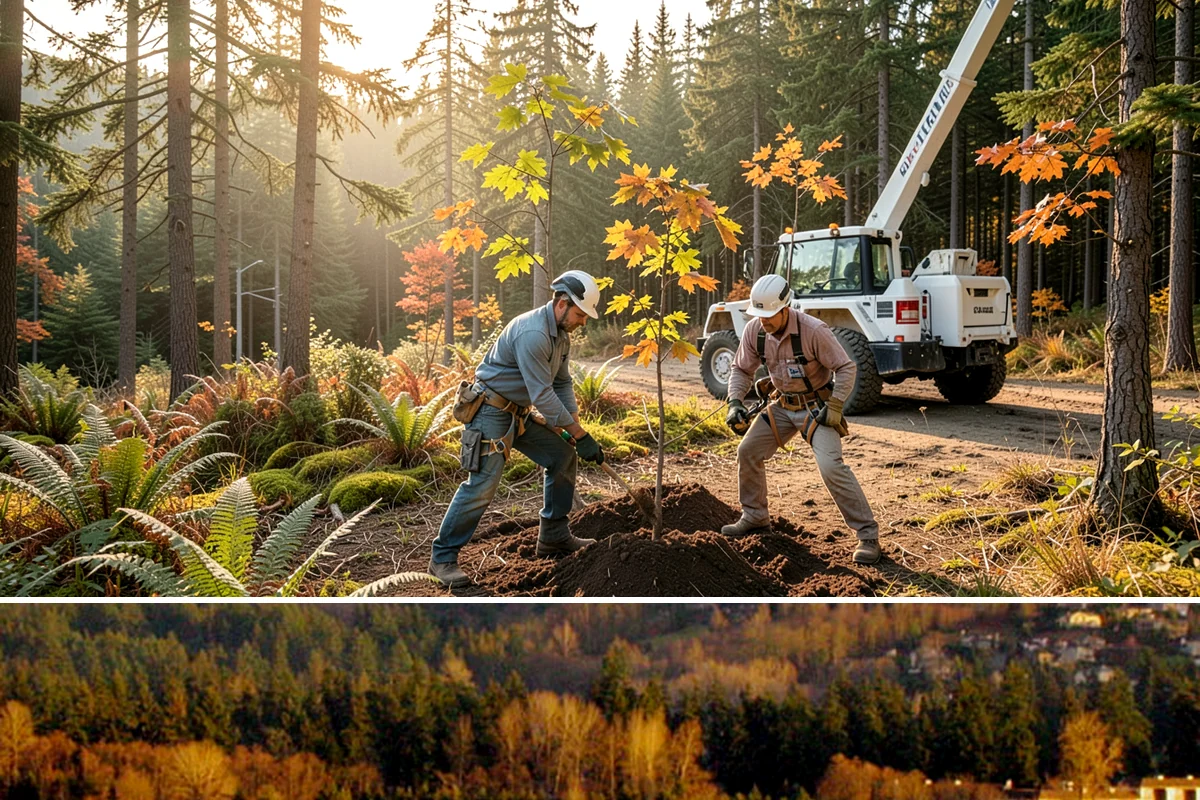
Our trained crews begin by assessing your yard to select suitable tree species for the location. They prepare the soil and planting area before placing each tree at the correct depth and spacing. Afterward, we mulch around the base, water in the new plants, and provide guidance to help them get established.
Equipment We Use for Kenmore Privacy Screen Planting
The work utilizes digging tools, watering equipment, and materials like soil amendments and mulch to support growth. We also bring staking supplies when necessary to keep young trees stable during their first growing season. All crew members wear personal protective gear while handling these specialized planting tools safely.
Kenmore Privacy Screen Planting Safety & Best Practices
Before any digging begins, we take steps to locate underground utilities to ensure everyone stays safe. Our crews select species suited to the site to prevent future conflicts with structures or other plants. We also plant at the proper depth and handle roots carefully to avoid damage during installation.
Signs You Need Privacy Screen Planting in Kenmore
You might need this service if you are looking for a natural way to screen your yard from neighbors or passersby. If noise or wind is currently making your outdoor space uncomfortable, a living screen can provide relief. This project also helps when you want to expand existing tree cover in an area that needs it most.
What Affects the Cost of Privacy Screen Planting in Kenmore
The final price depends on how easily equipment can reach the planting site and whether soil amendments are required. Different species have specific spacing requirements that influence the overall layout of your new screen. These factors, along with local conditions, determine the investment needed for a successful installation.
Best Time of Year for Kenmore Privacy Screen Planting
For the best results in our region, we recommend scheduling this work during dormant seasons or early spring. This timing allows tree roots to establish themselves firmly before the intense summer heat arrives. Waiting until these cooler periods ensures your new trees have the strongest possible start.

Choosing a privacy screen for your Kenmore property
Most screens fall into three approaches. Each one suits a different yard.
- Single row of evergreens. Trees spaced evenly in a line give the tallest, thickest screen. This works where you have a strip wide enough for mature width.
- Staggered double row. Two offset rows fill gaps faster and hold up if one plant fails. It needs more depth.
- Mixed hedge of evergreen and flowering shrubs. This fits narrow lots, gives lower screening, and adds seasonal interest. It will not block a second-story view.
What Kenmore soil means for the choice
The NRCS soil survey shows that 51% of Kenmore land has a hard or restrictive layer, such as glacial hardpan, within 40 inches of the surface. Alderwood is the most common soil series. That is survey data for the city as a whole, not a reading of your yard. But it matters here: water can sit above a hard layer, and roots may stay shallow. Before choosing species, we look at how your site drains. In slow-draining spots, plants that tolerate wet winters, planted slightly high, are a safer choice than ones that need dry feet.
The same survey of rainfall helps with timing. Daymet data for 2005 to 2025 shows 81% of Kenmore's yearly rain and snow falls from October to April. Fall planting lets roots settle in during the wet months. The first dry summer still needs regular watering.
Hardiness and staking
The USDA map places Kenmore in zone 9a, with parts of the city from 8b to 9a. That gives a wide plant list, but it is only a starting point. Exposure and drainage narrow it down.
If a tall tree needs stakes at planting, plan to take them off within about a year. WSU Extension warns that ties left on can girdle the trunk.
If you are weighing these options, call 425-484-4442 for a free estimate and we will talk through spacing and species for your boundary.
Kenmore tree conditions at a glance
| USDA hardiness zone | 9a (8b to 9a across the city) |
|---|---|
| Soils | 51% of land has hardpan or another restrictive layer within 40 in; most common series Alderwood |
| Rain and snow falling October to April | 81% of the year’s total |
| Days that freeze at night and thaw by day | 30 a year |
Tree removal rules in Kenmore
Kenmore’s published rules don’t spell out clearly which removals need city approval. We check with the city before work starts.
Most common street trees in Kenmore
- Douglas-fir11.3%
- Eastern arborvitae9.8%
- Red alder8.4%
- Western red cedar7.4%
- Bigleaf maple5.1%
- Black cottonwood4.8%
Share of 12,435 trees in the city’s street-tree inventory; median trunk diameter 10.0 in, 14.0% at 24 in or wider.
Sources: Daymet daily weather (NASA/ORNL), NOAA Storm Events, USDA plant hardiness map 2023, NRCS soil survey, USGS elevation, WA DNR landslide inventory, USDA Forest Service aerial survey, WSDA, city tree assessments and street-tree inventories, SILVIS Lab, Arbor Day Foundation, and official city and utility pages.
Privacy Screen Planting Serving Kenmore
Kenmore
Privacy screen planting in nearby areas
Also serving Kenmore
- Event & Seasonal Displays in Kenmoreat Washington Landscaping
- Municipal Irrigation Installation in Kenmoreat Washington City Services