Where Safety Meets Expert Tree Service.


Kenmore Storm-damaged Tree Removal
The removal of trees damaged by high winds, snow, ice, or lightning.
Is a storm-damaged tree an emergency or can it wait? It depends on what it is leaning on or hanging over. If a tree or large limb is touching a house, a power line, or a driveway you need, treat it as urgent. Stay clear, keep people and pets away, and call for help.
If the tree has fallen but is resting on open ground, the risk is lower, though cracked trunks and torn roots can shift without warning. Take photos from a safe distance before anything is moved. They help with insurance and with planning the cleanup.
About Storm-damaged Tree Removal in Kenmore
When high winds, snow, ice, or lightning strike your property, our team is ready to help remove trees that have been broken, split, or uprooted. This specialized removal service restores safety and clears space for you after severe weather events occur throughout the Puget Sound region.
What Kenmore Storm-damaged Tree Removal Includes
Storm-damaged tree removal focuses on safely taking down trees compromised by extreme conditions like heavy snow loads or lightning strikes. Our trained crews follow recognized arboricultural standards to match their methods with your specific tree species, site conditions, and access points.
Kenmore Storm-damaged Tree Removal Process
We begin each job with an on-site assessment to evaluate hazards before establishing clear drop zones and a safety perimeter. The crew then rigs the damaged sections for controlled lowering or fells the stem in a careful sequence while processing the wood nearby. Finally, we haul away all debris and complete a thorough cleanup of your property site.
Equipment We Use for Kenmore Storm-damaged Tree Removal
Our work relies on chainsaws and climbing gear to access trees safely without causing further damage to surrounding areas. Depending on the size of the tree or obstacles present, we may use aerial lifts or cranes alongside wood chippers for efficient processing. We also utilize ground protection mats and personal protective equipment to keep everyone safe during operations.
Kenmore Storm-damaged Tree Removal Safety & Best Practices
Before any climbing begins, our crew inspects trees for hidden decay and structural defects that could change how the tree falls. It is critical to identify overhead utility lines early in the process to ensure a controlled fall path away from power sources. We maintain clear drop zones at all times while using coordinated ground communication between climbers and those managing equipment below.
Signs You Need Storm-damaged Tree Removal in Kenmore
You likely need this service if you notice your trees are leaning unpredictably or show signs of splitting after recent storms. Situations where debris blocks access to parts of your yard or threatens nearby structures indicate that immediate removal is necessary. Hidden internal damage often becomes visible only when a tree has been weakened by ice, wind, or lightning strikes.
What Affects the Cost of Storm-damaged Tree Removal in Kenmore
The final cost for removing storm-damaged trees depends on factors like the extent of hidden decay within the trunk and branches. Proximity to power lines, limited access for heavy equipment, and an unpredictable lean can also influence how much time is required for safe removal. These variables mean that each job requires a customized plan rather than a standard pricing structure.
Best Time of Year for Kenmore Storm-damaged Tree Removal
This service is performed year-round in our area whenever severe weather events like high winds or ice storms occur throughout the Puget Sound region. There are no specific seasons when this work stops; instead, we respond promptly after any event breaks, splits, or uproots trees on your property. Our schedule adjusts based on when these dangerous conditions happen to ensure you get help as soon as it is needed.
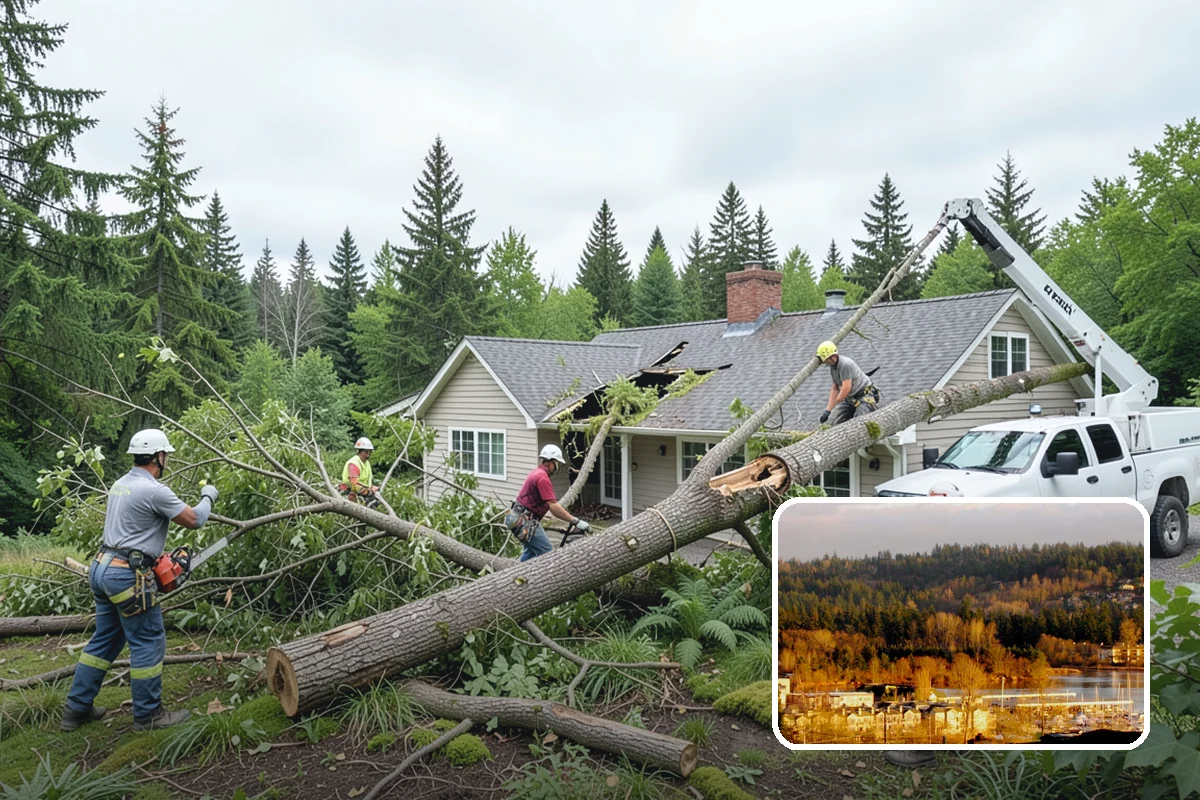
Storm-damaged tree removal in Kenmore: what to expect
Why storm work in Kenmore is not routine
The National Weather Service forecast zone that includes Kenmore logged 33 high and strong wind episodes from 2005 to 2025. The strongest gust recorded in that zone since 2005 was 72 mph on December 17, 2010. These are zone-wide figures, not readings for your lot. They do show that damaging wind is a repeat event here, so a tree that survived one storm may still carry a cracked union or loosened roots into the next.
How we approach a damaged tree
Fallen and hanging trees hold stored tension. A trunk pinned under another trunk can spring when cut. Work usually starts by assessing where the weight sits, then removing the load in controlled sections instead of making one cut and hoping. Our ISA Certified Arborist can also judge whether a leaning or split tree is better removed than left standing. Free estimates are available, and you can call or text 425-484-4442.
If a tree is on a power line, do not approach it. Call the utility first.
City approval and possible tax relief
The published Kenmore tree rules we found do not clearly say which removals need city approval. So we check with the city before work starts, rather than guess. If the tree is an immediate hazard, tell us that when you call.
Separately, the Washington Department of Revenue offers reduced property taxes for property damaged in a state-declared disaster, as noted in WA DNR's Tree Link article "Making Urban Forests Stronger, Part 1 - Before the Storm" (January 14, 2026). Whether that applies depends on whether a disaster was declared for your storm, so keep your photos and records of the damage.
Kenmore tree conditions at a glance
| High and strong wind episodes, 2005-2025 | 33 in the forecast zone |
|---|---|
| Ice storm episodes, 2005-2025 | 2 in the forecast zone |
| Average snowfall | 5 in a season |
| Soils | 51% of land has hardpan or another restrictive layer within 40 in; most common series Alderwood |
| Rain and snow falling October to April | 81% of the year’s total |
| Electric utility | Puget Sound Energy (PSE) |
Tree removal rules in Kenmore
Kenmore’s published rules don’t spell out clearly which removals need city approval. We check with the city before work starts.
Trees near the power line to your house
Puget Sound Energy (PSE): Service line (wire from PSE pole to home or meter pole): PSE does not trim it; homeowner/private arborist trims.
PSE performs a safety disconnection so the homeowner or private tree trimmer/arborist can work; Call at least 5 business days ahead to check crew availability and potential charges.
Safety disconnect: 1-888-321-7779 (5+ business days ahead). Utility page.
Any fee for a disconnect is set by the utility.
Strongest wind events near Kenmore
- Dec 17, 2010: gusts to 72 mph
- Feb 7, 2012: gusts to 70 mph
- Dec 14, 2006: gusts to 68 mph
NOAA Storm Events, forecast zone that includes Kenmore, 2005-2025.
Sources: Daymet daily weather (NASA/ORNL), NOAA Storm Events, USDA plant hardiness map 2023, NRCS soil survey, USGS elevation, WA DNR landslide inventory, USDA Forest Service aerial survey, WSDA, city tree assessments and street-tree inventories, SILVIS Lab, Arbor Day Foundation, and official city and utility pages.
Storm-damaged Tree Removal Serving Kenmore
Kenmore


Storm-damaged tree removal in nearby areas
Also serving Kenmore
- Bulb Planting in Kenmoreat Washington Landscaping
- Root Pruning in Kenmoreat Washington City Services
- Log Bucking in Kenmoreat Washington Firewood