Where Safety Meets Expert Tree Service.

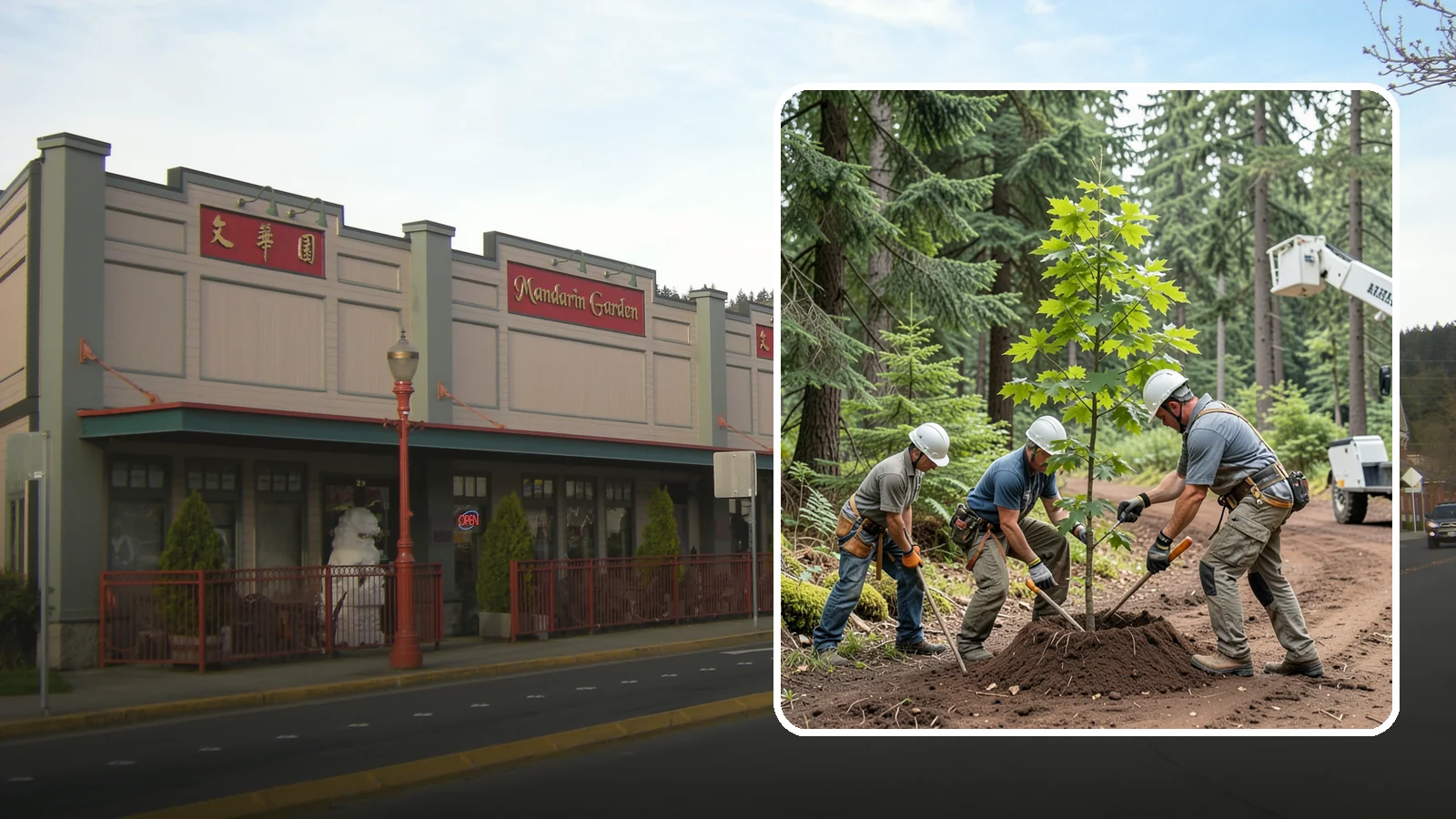
Issaquah Reforestation Planting
Larger-scale planting to re-establish tree cover.
Reforestation planting is for Issaquah owners with open ground that used to hold trees: a slope cleared after storm damage or removal, a back lot with a thin canopy, or acreage where dead trees have come down. It also fits owners who want to replace what was lost with something that will last.
The first choice is how many trees to plant and what size to start with. The second is how to handle steep ground, where planting is harder and the site needs a closer look. Below we compare the main approaches and the local conditions that favor each.
About Reforestation Planting in Issaquah
Reforestation planting helps homeowners restore tree cover on larger areas that have been cleared or degraded. This approach brings back the benefits of shade, privacy, and improved site ecology for your property. Our trained crews work to establish healthy trees that are well-suited to your specific location.
What Issaquah Reforestation Planting Includes
This service focuses on re-establishing broad canopy coverage rather than planting individual specimens in isolation. We match our methods carefully to the tree species chosen, current site conditions, and available access points. The goal is to create a resilient forest layer that supports long-term environmental health for your land.
Issaquah Reforestation Planting Process
Our team begins by assessing your site to select suitable species before preparing the soil and planting area. Each tree is planted at the correct depth with proper spacing, followed by mulching and watering in. We also provide guidance on establishment care to ensure these new trees thrive as they grow into a mature canopy.
Equipment We Use for Issaquah Reforestation Planting
The work utilizes digging tools for site preparation alongside equipment designed specifically for efficient planting operations. Soil amendments and fresh mulch are applied to support root development, while specialized watering gear ensures adequate moisture levels. Staking materials and personal protective equipment are used whenever necessary to secure young trees and keep crews safe.
Issaquah Reforestation Planting Safety & Best Practices
Before any ground is broken, we locate underground utilities to prevent damage during the digging process. We strictly select species suited to your site conditions to avoid future conflicts with structures or other vegetation. Planting at the proper depth and handling roots carefully are essential steps that protect both the new trees and our workers.
Signs You Need Reforestation Planting in Issaquah
You may need this service if you have areas of land where tree cover has been lost due to clearing or degradation. Signs include compacted soil, existing gaps in your canopy, or a desire to expand privacy and shade across a larger footprint. This project is ideal when the goal is to restore ecological balance rather than just adding isolated trees.
What Affects the Cost of Reforestation Planting in Issaquah
The overall investment depends on how accessible your site is for our crews and equipment teams. Costs are also influenced by soil conditions that might require amendments, the complexity of species selection, and whether staking or specialized watering gear is needed. These factors determine the resources required to successfully establish a new forest layer on your property.
Best Time of Year for Issaquah Reforestation Planting
In Washington’s Puget Sound climate, planting is generally best performed during dormant seasons to minimize stress on young trees. However, specific timing must always match the unique establishment requirements of the tree species you choose for your site. We will coordinate with you to schedule work when conditions are optimal for successful root growth and survival.

Choosing a planting approach on Issaquah sites
Owners usually choose between a few approaches. Which one fits depends on the slope, the species lost, and how much care you can give the site after planting.
- Small container or bare-root stock, planted close together. Cheaper to handle and easier to carry onto sloped ground. It needs more watering and protection while young.
- Larger container or balled trees, planted farther apart. Gives faster visual cover. Heavier to move, so access matters.
- Mixed species instead of replacing like with like. Spreads risk if one problem hits one species.
Why mixing species makes sense here
A federal aerial survey of forest within 10 km of Issaquah (USDA Forest Service and WA DNR, 2021 to 2025) mapped 7,786 acres of decline with no cause identified, mostly in bigleaf maple and western redcedar. That means dieback with no single cause found. It covers forest land, not yard trees, but it is a reason not to plant one species across the whole site. The same survey mapped 2,827 acres of bear damage in Douglas-fir and 1,132 acres of heat damage across all species.
Slopes and planting details
USGS elevation data shows Issaquah has a lot of steep ground compared with other Puget Sound cities. On a slope, we plan where people and equipment can reach, and we favor smaller stock where carrying larger trees would disturb the soil.
At planting, we straighten or cut circling roots. WSU Extension notes that circling roots can cause poor anchorage up to 30 years later, so this step matters more than the size of the tree.
Issaquah sits in USDA hardiness zone 8b, with parts of the city from 8b to 9a. That range is mild enough for most Pacific Northwest conifers and broadleaf trees, so species choice can follow the site rather than cold limits.
If removal of existing trees is part of the job, we check with the city before work starts. Call or text 425-484-4442 for a free estimate.
Issaquah tree conditions at a glance
| USDA hardiness zone | 8b (8b to 9a across the city) |
|---|---|
| Soils | 45% of land has hardpan or another restrictive layer within 40 in; most common series Alderwood; 33% well drained |
| Rain and snow falling October to April | 81% of the year’s total |
| Days that freeze at night and thaw by day | 33 a year |
| Tree City USA | 33 years |
Tree removal rules in Issaquah
A Tree Permit is required to remove significant trees; the only exemptions are removal of nonsignificant trees not otherwise protected, pruning that is not 'excessive', public agency/utility work in ROW/easements, and mineral extraction. Each removal must meet approval criteria in IMC 18.812.050 (e.g., nuisance trees, replacing dead significant trees, dying or diseased trees with qualified arborist recommendations).
Regulated size: 6 in.+ DBH, or alder/cottonwood 8 in.+ DBH, excluding King County Noxious Weed List species (per search-index text of city tree-code document.
Official city source. Rules change; we confirm with the city before work starts.
Sources: Daymet daily weather (NASA/ORNL), NOAA Storm Events, USDA plant hardiness map 2023, NRCS soil survey, USGS elevation, WA DNR landslide inventory, USDA Forest Service aerial survey, WSDA, city tree assessments and street-tree inventories, SILVIS Lab, Arbor Day Foundation, and official city and utility pages.
Reforestation Planting Serving Issaquah
Issaquah
Reforestation planting in nearby areas
Also serving Issaquah
- Native Plant Installation in Issaquahat Washington Landscaping
- Municipal Bark Installation in Issaquahat Washington City Services