Where Safety Meets Expert Tree Service.


Issaquah Storm-damaged Tree Removal
The removal of trees damaged by high winds, snow, ice, or lightning.
Issaquah's tree code allows hazardous trees to be removed before a permit is obtained when conditions are an emergency, meaning immediate danger to life, dwellings or similar valuable property. If a storm has left a tree leaning on your house or hanging over a driveway, that detail shapes your first steps.
Start by keeping people and vehicles away from the tree and anything it touches. Take photos from a safe distance. Stay clear of any wires. Then call us to talk through what you are seeing and what needs to happen first.
About Storm-damaged Tree Removal in Issaquah
When high winds, snow, ice, or lightning strike your property, our team is ready to help remove trees that have been broken, split, or uprooted. This specialized removal service restores safety and clears space for you after severe weather events occur throughout the Puget Sound region.
What Issaquah Storm-damaged Tree Removal Includes
Storm-damaged tree removal focuses on safely taking down trees compromised by extreme conditions like heavy snow loads or lightning strikes. Our trained crews follow recognized arboricultural standards to match their methods with your specific tree species, site conditions, and access points.
Issaquah Storm-damaged Tree Removal Process
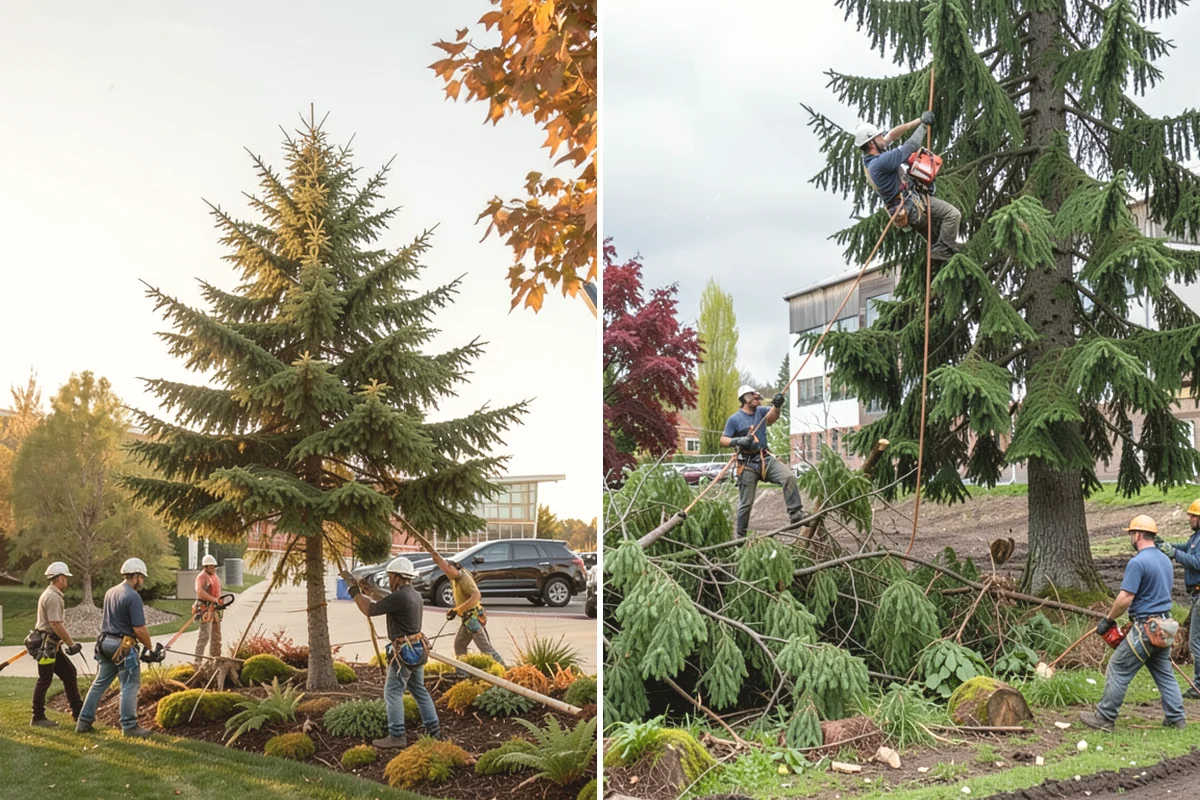
We begin each job with an on-site assessment to evaluate hazards before establishing clear drop zones and a safety perimeter. The crew then rigs the damaged sections for controlled lowering or fells the stem in a careful sequence while processing the wood nearby. Finally, we haul away all debris and complete a thorough cleanup of your property site.
Equipment We Use for Issaquah Storm-damaged Tree Removal
Our work relies on chainsaws and climbing gear to access trees safely without causing further damage to surrounding areas. Depending on the size of the tree or obstacles present, we may use aerial lifts or cranes alongside wood chippers for efficient processing. We also utilize ground protection mats and personal protective equipment to keep everyone safe during operations.
Issaquah Storm-damaged Tree Removal Safety & Best Practices
Before any climbing begins, our crew inspects trees for hidden decay and structural defects that could change how the tree falls. It is critical to identify overhead utility lines early in the process to ensure a controlled fall path away from power sources. We maintain clear drop zones at all times while using coordinated ground communication between climbers and those managing equipment below.
Signs You Need Storm-damaged Tree Removal in Issaquah
You likely need this service if you notice your trees are leaning unpredictably or show signs of splitting after recent storms. Situations where debris blocks access to parts of your yard or threatens nearby structures indicate that immediate removal is necessary. Hidden internal damage often becomes visible only when a tree has been weakened by ice, wind, or lightning strikes.
What Affects the Cost of Storm-damaged Tree Removal in Issaquah
The final cost for removing storm-damaged trees depends on factors like the extent of hidden decay within the trunk and branches. Proximity to power lines, limited access for heavy equipment, and an unpredictable lean can also influence how much time is required for safe removal. These variables mean that each job requires a customized plan rather than a standard pricing structure.
Best Time of Year for Issaquah Storm-damaged Tree Removal
This service is performed year-round in our area whenever severe weather events like high winds or ice storms occur throughout the Puget Sound region. There are no specific seasons when this work stops; instead, we respond promptly after any event breaks, splits, or uproots trees on your property. Our schedule adjusts based on when these dangerous conditions happen to ensure you get help as soon as it is needed.

Storm-damaged tree removal in Issaquah: what happens and why
Storm work is different from routine removal. Trees under tension from a break or a lean can move without warning when cut. The order of the work matters.
How the work usually goes
- Assess the tree and the site: where the weight is, what it rests on, and what lies in its path.
- Decide what is urgent. A tree pressing on a roof is handled before one down in an open lawn.
- Take the tree apart in controlled sections, relieving tension in the right sequence.
- Clear the debris and talk through what is left, such as a stump or a damaged neighbor tree.
The city rule and your paperwork
The Issaquah code, IMC 18.812.050(D), says any number of hazardous trees may be removed before obtaining a permit under emergency conditions, which it describes as immediate danger to life, dwellings or similar valuable property. Hazardous-tree permits have no fee. That rule covers removal. It does not speak to pruning or other work, and not every storm-damaged tree meets the emergency test. If your situation is unclear, we check with the city before work starts. Keep your photos, since they document the condition of the tree.
Why storms are worth planning for
The forecast zone that includes Issaquah logged 33 high and strong wind episodes from 2005 to 2025, according to federal weather records. The strongest gust recorded in that zone since 2005 was 72 mph on December 17, 2010. These are zone-wide figures, not a measure of any one tree. They do show that wind is a repeat event here, so a damaged tree that is left standing may face another one.
Surviving trees on your lot deserve a look too. WSU Extension's Pacific Northwest Gardener's Handbook notes that over-thinning, called lion's-tailing, puts weight at branch tips and raises the risk of failure in windstorms. If a tree was pruned that way, tell us. Our ISA Certified Arborist can look at whether the remaining structure is sound. Estimates are free.
Issaquah tree conditions at a glance
| High and strong wind episodes, 2005-2025 | 33 in the forecast zone |
|---|---|
| Ice storm episodes, 2005-2025 | 2 in the forecast zone |
| Average snowfall | 7.8 in a season |
| Soils | 45% of land has hardpan or another restrictive layer within 40 in; most common series Alderwood; 33% well drained |
| Rain and snow falling October to April | 81% of the year’s total |
| Electric utility | Puget Sound Energy (PSE) |
Tree removal rules in Issaquah
A Tree Permit is required to remove significant trees; the only exemptions are removal of nonsignificant trees not otherwise protected, pruning that is not 'excessive', public agency/utility work in ROW/easements, and mineral extraction. Each removal must meet approval criteria in IMC 18.812.050 (e.g., nuisance trees, replacing dead significant trees, dying or diseased trees with qualified arborist recommendations).
Regulated size: 6 in.+ DBH, or alder/cottonwood 8 in.+ DBH, excluding King County Noxious Weed List species (per search-index text of city tree-code document.
Official city source. Rules change; we confirm with the city before work starts.
Trees near the power line to your house
Puget Sound Energy (PSE): Service line (wire from PSE pole to home or meter pole): PSE does not trim it; homeowner/private arborist trims.
PSE performs a safety disconnection so the homeowner or private tree trimmer/arborist can work; Call at least 5 business days ahead to check crew availability and potential charges.
Safety disconnect: 1-888-321-7779 (5+ business days ahead). Utility page.
Any fee for a disconnect is set by the utility.
Strongest wind events near Issaquah
- Dec 17, 2010: gusts to 72 mph
- Feb 7, 2012: gusts to 70 mph
- Dec 14, 2006: gusts to 68 mph
NOAA Storm Events, forecast zone that includes Issaquah, 2005-2025.
Sources: Daymet daily weather (NASA/ORNL), NOAA Storm Events, USDA plant hardiness map 2023, NRCS soil survey, USGS elevation, WA DNR landslide inventory, USDA Forest Service aerial survey, WSDA, city tree assessments and street-tree inventories, SILVIS Lab, Arbor Day Foundation, and official city and utility pages.
Storm-damaged Tree Removal Serving Issaquah
Issaquah
Storm-damaged tree removal in nearby areas
Also serving Issaquah
- Tree Planting in Issaquahat Washington Landscaping
- Park Tree Maintenance in Issaquahat Washington City Services
- Firewood Recycling in Issaquahat Washington Firewood