Where Safety Meets Expert Tree Service.


Yarrow Point Tree Bracing
The installation of rods to reinforce splits or weak unions.
You may have noticed a tree with a tight V-shaped fork, a crack or seam where two stems meet, or a large limb that sags and moves more than its neighbors in a breeze. Those are the usual reasons people start asking about bracing.
Bracing adds support to a tree that has a structural weakness but is otherwise worth keeping. It does not make a tree wind-proof, and it does not suit every defect. A close look at the tree comes first, and that look decides whether bracing, pruning or removal is the sensible path.
About Tree Bracing in Yarrow Point
Tree bracing is a supportive solution designed to help homeowners protect their most valued trees from structural stress. By reinforcing weak points in the trunk or branches, we can extend the safe life of significant specimens on your property. This service works well for any location where mature trees face challenges like heavy limbs or included-bark unions.
What Yarrow Point Tree Bracing Includes
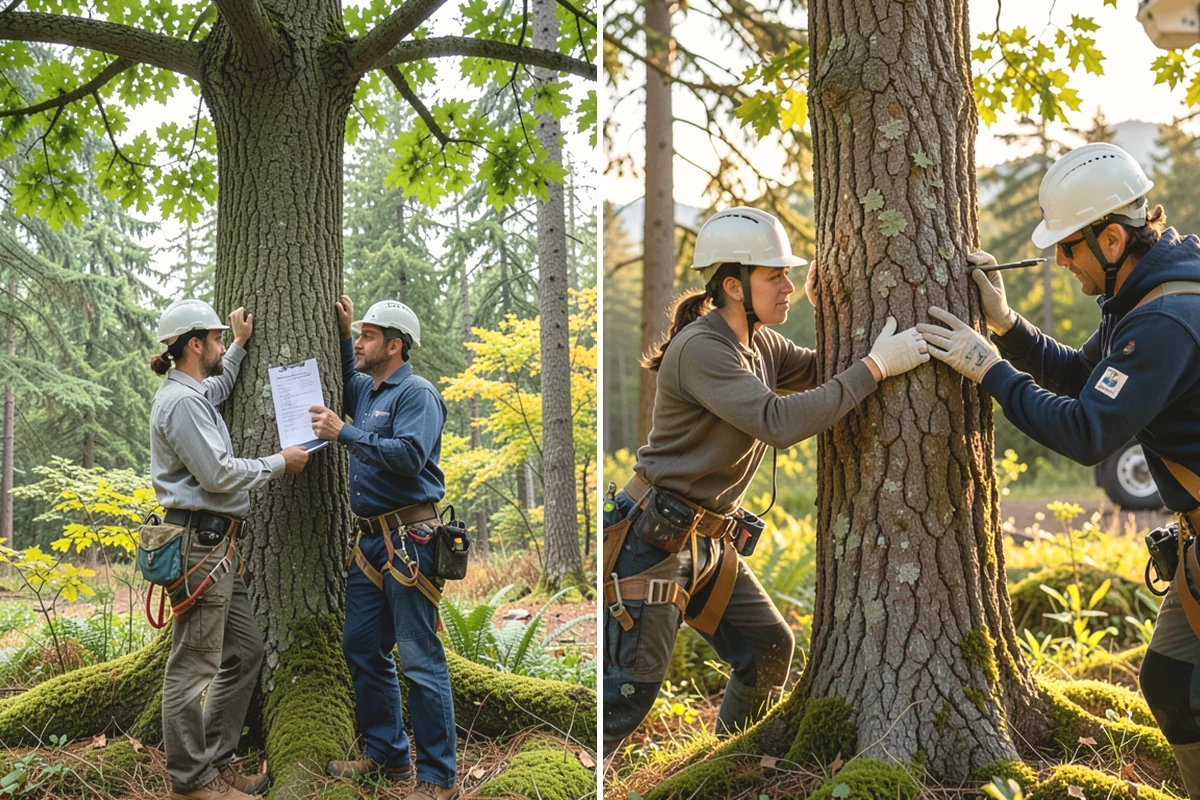
Tree bracing involves installing rods to reinforce splits and strengthen cracks within a tree’s structure. We specifically target weak unions and included-bark areas that are prone to failure under load. Our work is tailored to the specific needs of your tree species, site conditions, and access requirements.
Yarrow Point Tree Bracing Process
The typical process begins with an assessment of structural defects and how loads travel through the tree. Once a suitable support system is selected, trained crews install hardware at precise positions following recognized arboricultural standards. We document every installation and set up a schedule for future inspections to ensure long-term stability.
Equipment We Use for Yarrow Point Tree Bracing
Our teams utilize specialized cabling and bracing hardware along with professional installation tools to complete the job safely. Depending on the tree’s height and location, we may use climbing rigging gear or an aerial lift to reach work areas effectively. All crew members wear necessary personal protective equipment throughout the project.
Yarrow Point Tree Bracing Safety & Best Practices
We install support systems only where they are appropriate and effective for preventing limb or stem failure. It is critical that all hardware used is correctly rated for the specific forces it will encounter over time. Periodic inspections help recognize when aging hardware needs replacement or if removal becomes the safer option for your tree’s health.
Signs You Need Tree Bracing in Yarrow Point
You may need this service if you notice cracks, cavities, or included-bark unions forming in your trees’ trunks or branches. Overextended limbs that struggle to support their own weight are another common situation where bracing provides necessary relief. Identifying these issues early helps preserve valued trees before they become hazardous risks for people nearby.
What Affects the Cost of Tree Bracing in Yarrow Point
The cost of tree bracing is influenced by the number of rods required to adequately reinforce your specific tree. Factors such as species-specific hardware selection and site access conditions also play a major role in determining the final price. Additionally, documenting installations with detailed inspection schedules adds complexity that affects overall costs for the project.
Best Time of Year for Yarrow Point Tree Bracing
While work can be performed year-round, we typically schedule projects when trees have full foliage to accurately assess load paths. Freezing temperatures may affect installation safety or require specialized rigging gear, so timing is adjusted based on weather conditions. Planning your service during these optimal windows ensures that our crews can perform the job with maximum efficiency and care.

Why Tree Bracing Matters in Yarrow Point Winds and Storms
Most bracing jobs start with a weak union. Two stems grow upward from one point and press against each other. Bark gets trapped between them, so there is no strong wood joining the stems. Add the weight of wet foliage and a strong wind, and the fork can split.
Local weather shows why that matters. Weather records for the forecast zone that includes Yarrow Point list 33 high and strong wind episodes from 2005 to 2025. The strongest gust recorded in that zone since 2005 was 72 mph on December 17, 2010. The same records show 2 ice storm episodes. Wind and ice both load a weak fork repeatedly, so a defect that has held for years can fail in one event. These are zone figures, not measurements of any tree on your property.
The work itself follows standard practice, such as the ISA and ANSI A300 guidelines. For a split or weak fork, an arborist may install a steel rod through both stems, often with a cable higher in the crown to share the load. Hardware is placed according to where the tree is likely to move. Bracing is also checked on a schedule, because trees keep growing around the hardware and it needs inspection over time.
Timing matters too. A Washington DNR Forest Health Program study of beetle activity after a Pacific Coast windstorm found that most bark and ambrosia beetles build up in windthrown trees, with bigger flights in the second and third years after a storm. A tree that has cracked or partly failed is already stressed, and stressed wood is easier for pests to exploit. If you see a fresh split, acting early gives you more options than waiting for the next storm.
Not every tree should be braced. If decay is advanced or the split is severe, removal may be safer. Before any work starts, we check with the city of Yarrow Point about whether a permit applies. Call or text 425-484-4442 for a free estimate with an ISA Certified Arborist.
Yarrow Point tree conditions at a glance
| High and strong wind episodes, 2005-2025 | 33 in the forecast zone |
|---|---|
| Ice storm episodes, 2005-2025 | 2 in the forecast zone |
| Average snowfall | 5.4 in a season |
| Soils | 93% of land has hardpan or another restrictive layer within 40 in; most common series Alderwood |
Strongest wind events near Yarrow Point
- Dec 17, 2010: gusts to 72 mph
- Feb 7, 2012: gusts to 70 mph
- Dec 14, 2006: gusts to 68 mph
NOAA Storm Events, forecast zone that includes Yarrow Point, 2005-2025.
Sources: Daymet daily weather (NASA/ORNL), NOAA Storm Events, USDA plant hardiness map 2023, NRCS soil survey, USGS elevation, WA DNR landslide inventory, USDA Forest Service aerial survey, WSDA, city tree assessments and street-tree inventories, SILVIS Lab, Arbor Day Foundation, and official city and utility pages.
Tree Bracing Serving Yarrow Point
Yarrow Point