Where Safety Meets Expert Tree Service.


Yarrow Point Diseased Tree Removal
The removal of trees affected by disease beyond recovery.
This service is for Yarrow Point owners who have a tree that looks sick: a crown thinning out, branches dying back, fungus at the base, or leaves that are small and clumped when they should be full. It also fits owners who are not sure whether the tree is diseased or just stressed.
The first step is to get the tree looked at before deciding anything. Take dated photos of the whole tree, the trunk base and any dead limbs. Note what changed and when. That record helps an arborist tell the options apart and, if the city requires a permit, it gives you the images the city asks for.
About Diseased Tree Removal in Yarrow Point
When a tree on your property is affected by disease beyond recovery, our team can help remove it safely and efficiently. This specialized removal protects nearby healthy trees from infection while clearing away potential safety hazards for you and your family. We work with homeowners throughout the service area to restore peace of mind after an illness has compromised their landscape.
What Yarrow Point Diseased Tree Removal Includes
Diseased tree removal focuses on taking down trees where disease has weakened the structure or threatens to spread further. Our trained crews follow recognized arboricultural standards, tailoring every method to match your specific tree species and site conditions. This service ensures that hazardous limbs are lowered safely while minimizing impact on surrounding areas during the work.
Yarrow Point Diseased Tree Removal Process
The typical workflow begins with an on-site assessment to evaluate hazards before establishing clear drop zones and safety perimeters. We then rig and lower branches or fell the stem in a controlled sequence, followed by processing the wood and clearing debris from your property. Once all materials are hauled away, we complete final site cleanup to leave your landscape looking tidy again.
Equipment We Use for Yarrow Point Diseased Tree Removal
Our crews utilize chainsaws, climbing gear, and rigging equipment to handle trees of various sizes safely. Depending on access needs and tree location, we may also bring in a wood chipper, aerial lift, or crane as required for the job. Ground protection measures are always used alongside personal protective equipment to keep everyone safe during operations.
Yarrow Point Diseased Tree Removal Safety & Best Practices
Safety is our priority, so we maintain clear drop zones and follow controlled fall paths at all times. Before starting any work, we identify overhead utility lines and inspect trees for hidden decay or structural defects that could affect climbing safety. Coordinated ground communication and proper use of fall protection ensure a secure environment throughout the removal process.
Signs You Need Diseased Tree Removal in Yarrow Point
You may need this service if you notice disease has compromised your tree’s structure or poses a risk to nearby healthy plants. Other indicators include situations where the infection threatens to spread, creating an urgent need for professional intervention before conditions worsen. Recognizing these signs early helps prevent further damage to your property and surrounding vegetation.
What Affects the Cost of Diseased Tree Removal in Yarrow Point
The cost of removal is influenced by factors such as tree size and site access limitations like proximity to structures or power lines. Hidden internal decay severity also plays a role, along with the complexity required for processing wood debris after felling. These variables determine the resources needed to complete your project safely without inventing specific price estimates.
Best Time of Year for Yarrow Point Diseased Tree Removal
Work can be performed year-round in our local climate, offering flexibility when you need urgent removal services completed quickly. However, extra caution is advised during wet seasons due to slippery conditions that may affect rigging operations and ground stability. Planning ahead for these weather patterns helps ensure a smooth and safe execution of your diseased tree project.
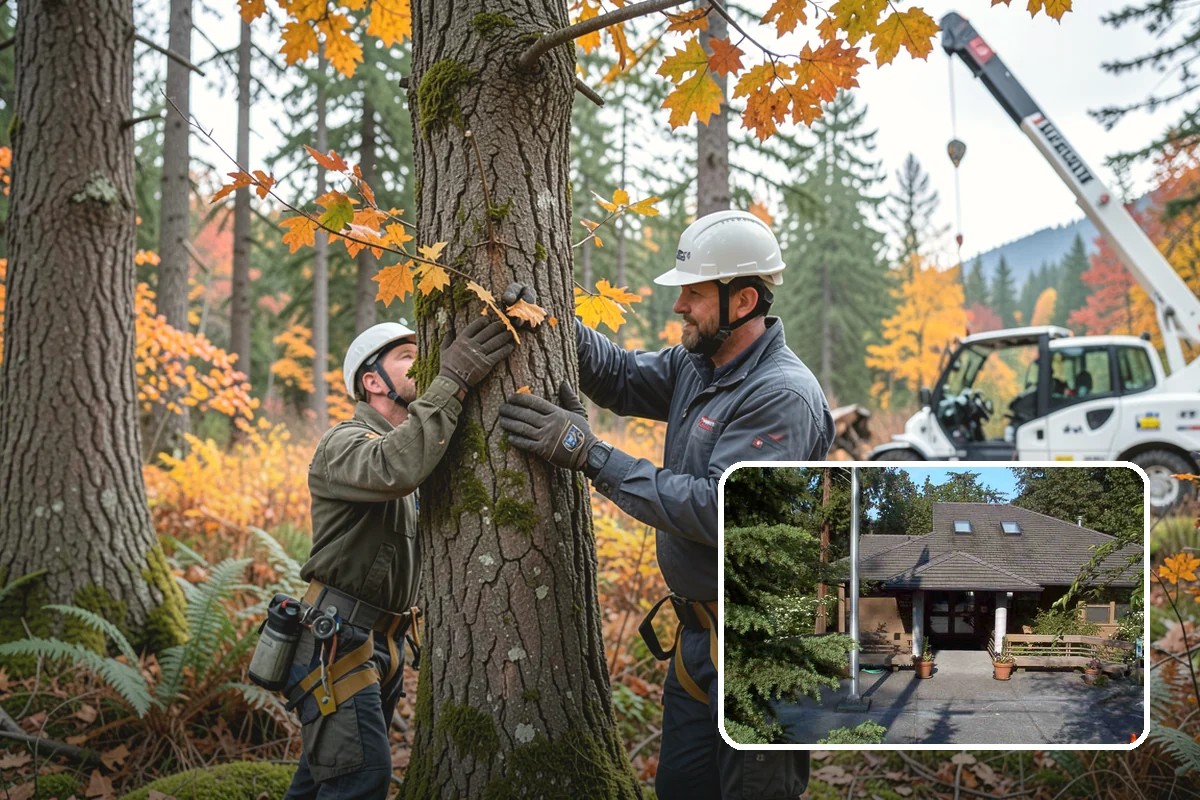
Diseased tree options in Yarrow Point: monitor, prune or remove
An owner with a declining tree usually chooses among three approaches. Which one fits depends on the cause, how much of the tree is affected and what sits underneath it.
Monitor and re-inspect
If the tree is dropping a few leaves or has minor dieback and nothing valuable is below it, watching it over a season can be reasonable. Bigleaf maple is a good example. Typical decline symptoms are crown and branch dieback, clumps of shrunken leaves and heavy seed crops, according to WA DNR's Tree Link. Those signs point to a tree under stress, but they do not tell you how fast it will fail.
Prune out the dead or diseased parts
When the problem is limited to some limbs and the trunk and roots look sound, removing dead wood under standard ANSI A300 practice can reduce what might fall. It does not cure a root or trunk disease, and it will not help a tree that is failing at the base.
Remove the tree
Removal makes sense when the trunk is decayed, the roots are compromised, or the tree could hit a house, driveway or neighbor. Yarrow Point's code (YPMC 20.22.050) allows a hazardous tree posing extreme risk to be removed before a permit is issued. The owner must then submit a tree removal permit within seven days, with photos or video of the tree, its hazardous condition and what it could hit. For any tree that is not an extreme risk, we check with the city before work starts.
Two local details worth knowing
- A federal and state aerial survey (USDA Forest Service and WA DNR, 2021-2025) of forest within 10 km of Yarrow Point mapped 134 acres of western redcedar in decline with no cause identified. That is forest land, not yard trees, but it shows redcedar dieback is worth taking seriously.
- Emerald ash borer has been confirmed in Washington only near Vancouver and College Place (WSDA, 2026), not in Puget Sound counties. A thinning ash here is more likely something else.
Call or text 425-484-4442 for a free estimate, and our ISA Certified Arborist can help you decide which option fits.
Yarrow Point tree conditions at a glance
| USDA hardiness zone | 9a (8b to 9a across the city) |
|---|---|
| Soils | 93% of land has hardpan or another restrictive layer within 40 in; most common series Alderwood |
| Rain and snow falling October to April | 81% of the year’s total |
| Days with 0.1 in or more of rain | 108 a year |
| Days that freeze at night and thaw by day | 28 a year |
Tree health near Yarrow Point
- Decline, cause not identified134 ac
Forest damage mapped from the air within 10 km of Yarrow Point, 2021-2025 (USDA Forest Service and WA DNR). This covers forest land, not street or yard trees. “Decline, cause not identified” is dieback with no single cause found.
Sources: Daymet daily weather (NASA/ORNL), NOAA Storm Events, USDA plant hardiness map 2023, NRCS soil survey, USGS elevation, WA DNR landslide inventory, USDA Forest Service aerial survey, WSDA, city tree assessments and street-tree inventories, SILVIS Lab, Arbor Day Foundation, and official city and utility pages.
Diseased Tree Removal Serving Yarrow Point
Yarrow Point
Diseased tree removal in nearby areas
Also serving Yarrow Point
- Bulb Planting in Yarrow Pointat Washington Landscaping
- Street Tree Removal in Yarrow Pointat Washington City Services
- Fallen Tree Firewood in Yarrow Pointat Washington Firewood