Where Safety Meets Expert Tree Service.


Puyallup Diseased Tree Removal
The removal of trees affected by disease beyond recovery.
If a tree on your Puyallup lot looks sick, the first step is a written risk assessment, not a chainsaw. The city's tree code allows removal of regulated trees only when an ISA Tree Risk Assessment by a qualified arborist rates the tree high risk, or when it threatens infrastructure or utilities with no reasonable alternative.
Moderate risk may qualify with additional factors. Photos of dieback, fungal growth, oozing or cracks, along with the date you first noticed them, give the assessor a useful starting point.
About Diseased Tree Removal in Puyallup
When a tree on your property is affected by disease beyond recovery, our team can help remove it safely and efficiently. This specialized removal protects nearby healthy trees from infection while clearing away potential safety hazards for you and your family. We work with homeowners throughout the service area to restore peace of mind after an illness has compromised their landscape.
What Puyallup Diseased Tree Removal Includes
Diseased tree removal focuses on taking down trees where disease has weakened the structure or threatens to spread further. Our trained crews follow recognized arboricultural standards, tailoring every method to match your specific tree species and site conditions. This service ensures that hazardous limbs are lowered safely while minimizing impact on surrounding areas during the work.
Puyallup Diseased Tree Removal Process
The typical workflow begins with an on-site assessment to evaluate hazards before establishing clear drop zones and safety perimeters. We then rig and lower branches or fell the stem in a controlled sequence, followed by processing the wood and clearing debris from your property. Once all materials are hauled away, we complete final site cleanup to leave your landscape looking tidy again.
Equipment We Use for Puyallup Diseased Tree Removal
Our crews utilize chainsaws, climbing gear, and rigging equipment to handle trees of various sizes safely. Depending on access needs and tree location, we may also bring in a wood chipper, aerial lift, or crane as required for the job. Ground protection measures are always used alongside personal protective equipment to keep everyone safe during operations.
Puyallup Diseased Tree Removal Safety & Best Practices
Safety is our priority, so we maintain clear drop zones and follow controlled fall paths at all times. Before starting any work, we identify overhead utility lines and inspect trees for hidden decay or structural defects that could affect climbing safety. Coordinated ground communication and proper use of fall protection ensure a secure environment throughout the removal process.
Signs You Need Diseased Tree Removal in Puyallup
You may need this service if you notice disease has compromised your tree’s structure or poses a risk to nearby healthy plants. Other indicators include situations where the infection threatens to spread, creating an urgent need for professional intervention before conditions worsen. Recognizing these signs early helps prevent further damage to your property and surrounding vegetation.
What Affects the Cost of Diseased Tree Removal in Puyallup
The cost of removal is influenced by factors such as tree size and site access limitations like proximity to structures or power lines. Hidden internal decay severity also plays a role, along with the complexity required for processing wood debris after felling. These variables determine the resources needed to complete your project safely without inventing specific price estimates.
Best Time of Year for Puyallup Diseased Tree Removal
Work can be performed year-round in our local climate, offering flexibility when you need urgent removal services completed quickly. However, extra caution is advised during wet seasons due to slippery conditions that may affect rigging operations and ground stability. Planning ahead for these weather patterns helps ensure a smooth and safe execution of your diseased tree project.
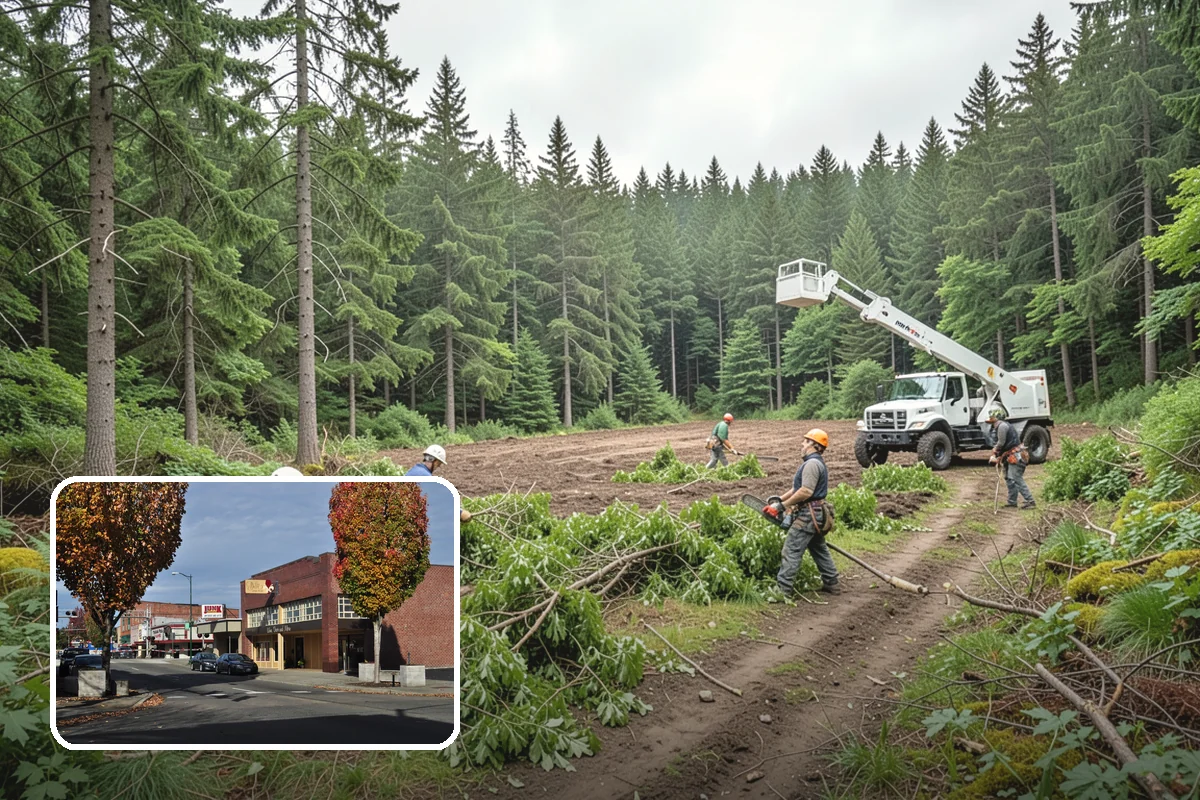
Diseased tree removal in Puyallup: assess first, then remove
Disease and decline do not always mean a tree must come down. Some trees can be treated or pruned. Others have lost structure in the roots or trunk. Here is how the work usually goes.
Steps from first look to removal
- Walk the tree and note symptoms: thinning or browning crown, dead limbs, conks or mushrooms at the base, bark loss, sap flow.
- Have an arborist assess it for risk, looking at the roots, trunk, and crown and at what sits beneath it, such as a house, driveway or power line.
- Confirm the city requirements before any cutting starts.
- If removal is approved, the crew takes the tree down in sections where space is tight, then handles the debris and stump as agreed.
Why the city rule shapes the timing
Puyallup's tree code, as published by the city, lists the conditions for removing regulated trees. I found no provision for after-the-fact approval in an emergency. That means documenting the risk before the work is the safer path. Where it is unclear whether a tree is regulated, we check with the city before work starts. The rule speaks to removal, so we also ask about other work rather than assuming.
What the regional data suggests
A 2021-2025 aerial survey by the USDA Forest Service and WA DNR covered forest within 10 km of Puyallup. It is forest land, not yard trees, so it says nothing about any one property. Its largest mapped category was decline with no cause identified, 1,101 acres, mostly in unknown hardwoods and western redcedar. That label means dieback where no single cause was found. State forest health reporting also notes that bark beetles, wood borers and root diseases on redcedar are usually secondary agents on trees already stressed. So a beetle-riddled cedar often points to an underlying problem, and an assessment should look at roots and site conditions, not just the insects.
The same survey mapped Douglas-fir engraver beetle damage on 273 acres. If you have a Douglas-fir with a fading crown, mention it during the assessment.
Call or text 425-484-4442 to set up a free estimate and an ISA Certified Arborist's assessment.
Puyallup tree conditions at a glance
| USDA hardiness zone | 8b |
|---|---|
| Soils | 13% of land has hardpan or another restrictive layer within 40 in; most common series Puyallup; 47% well drained |
| Rain and snow falling October to April | 81% of the year’s total |
| Days with 0.1 in or more of rain | 108 a year |
| Days that freeze at night and thaw by day | 29 a year |
Most common street trees in Puyallup
- Flowering Pear14.6%
- Hornbeam9.4%
- Crabapple8.9%
- Linden7.3%
- Ash6.9%
- Green ash5.9%
Share of 812 trees in the city’s street-tree inventory; median trunk diameter 9.5 in, 0.0% at 24 in or wider.
Tree health near Puyallup
Spongy moth (WSDA 2017): WSDA trap detection(s): 27 moth(s) in 13 trap catch record(s).
Spongy moth (WSDA 2012): WSDA eradication treatment (Btk).
- Decline, cause not identified1,101 ac
- Douglas-fir engraver273 ac
- Bears100 ac
Forest damage mapped from the air within 10 km of Puyallup, 2021-2025 (USDA Forest Service and WA DNR). This covers forest land, not street or yard trees. “Decline, cause not identified” is dieback with no single cause found.
Sources: Daymet daily weather (NASA/ORNL), NOAA Storm Events, USDA plant hardiness map 2023, NRCS soil survey, USGS elevation, WA DNR landslide inventory, USDA Forest Service aerial survey, WSDA, city tree assessments and street-tree inventories, SILVIS Lab, Arbor Day Foundation, and official city and utility pages.
Diseased Tree Removal Serving Puyallup
Puyallup
Also serving Puyallup
- Perennial Planting in Puyallupat Washington Landscaping
- Tree Inventory in Puyallupat Washington City Services
- Fallen Tree Firewood in Puyallupat Washington Firewood