Where Safety Meets Expert Tree Service.


Puyallup Confined-space Tree Removal
The careful dismantling of trees in tight or restricted areas.
In Puyallup's street-tree inventory, the median trunk diameter is 9.5 inches, and none of the inventoried trees are 24 inches or wider. That is a city-managed street sample, not your yard. Still, it is a useful reminder that many trees in tight spots are modest in size, and size shapes how a removal is done.
A confined-space removal means the tree stands where a crane or a clear drop zone is not an option: between buildings, beside a fence, over a patio, or near wires. Before you call, note what sits within reach of the tree, and take a few photos from different sides.
About Confined-space Tree Removal in Puyallup
If your property has trees growing very close to buildings or fences where standard removal isn’t possible, our confined-space tree removal service is designed for you. We help homeowners safely clear tight spots without damaging nearby structures or landscaping. This approach ensures that difficult-to-reach trees are handled with care and precision.
What Puyallup Confined-space Tree Removal Includes
Confined-space tree removal involves the careful dismantling of trees in restricted areas where there is little room for controlled felling. Our trained crews follow recognized arboricultural standards to match their methods to your specific tree species, site conditions, and access limitations. This service protects structures, utilities, and landscaping while removing safety hazards and reducing liability on your property.
Puyallup Confined-space Tree Removal Process
The work typically begins with an on-site assessment and hazard evaluation to establish safe drop zones and a perimeter around the job area. We then rig and lower limbs or fell the stem in a controlled sequence before processing the wood and clearing debris from the site. Final cleanup ensures the area is left tidy after all equipment has been removed.
Equipment We Use for Puyallup Confined-space Tree Removal
Our crews utilize chainsaws, climbing and rigging gear, and ground protection to navigate tight spaces safely. Depending on the specific conditions of your job site, we may also use a wood chipper or an aerial lift or crane as needed. All team members wear necessary personal protective equipment while operating these tools in confined areas.
Puyallup Confined-space Tree Removal Safety & Best Practices
Safety is our priority, so we maintain clear drop zones and controlled fall paths throughout every step of the project. Before starting any work, we identify overhead utility lines to prevent accidents during removal. We also inspect trees for decay and structural defects before climbing and use coordinated ground communication along with proper fall protection gear.
Signs You Need Confined-space Tree Removal in Puyallup
You likely need this service if hidden internal decay or unpredictable lean makes a tree dangerous in its current location. Situations where proximity to structures, fences, or power lines leaves no room for safe felling also indicate the need for our specialized approach. Limited access for standard equipment due to landscaping features is another clear sign that confined-space techniques are required.
What Affects the Cost of Confined-space Tree Removal in Puyallup
The cost of this service is influenced by factors such as tree size and any hidden internal decay present in the trunk or branches. Proximity to structures like buildings and fences, along with limited access for heavy machinery, will also impact the overall price. Additionally, specific debris disposal requirements can affect how much you pay for removal.
Best Time of Year for Puyallup Confined-space Tree Removal
This service can be performed year-round given our local climate conditions. However, we require extra caution during wet seasons when ground conditions may compromise safety perimeters or rigging stability. We adjust our methods to ensure the site remains safe regardless of recent weather patterns.
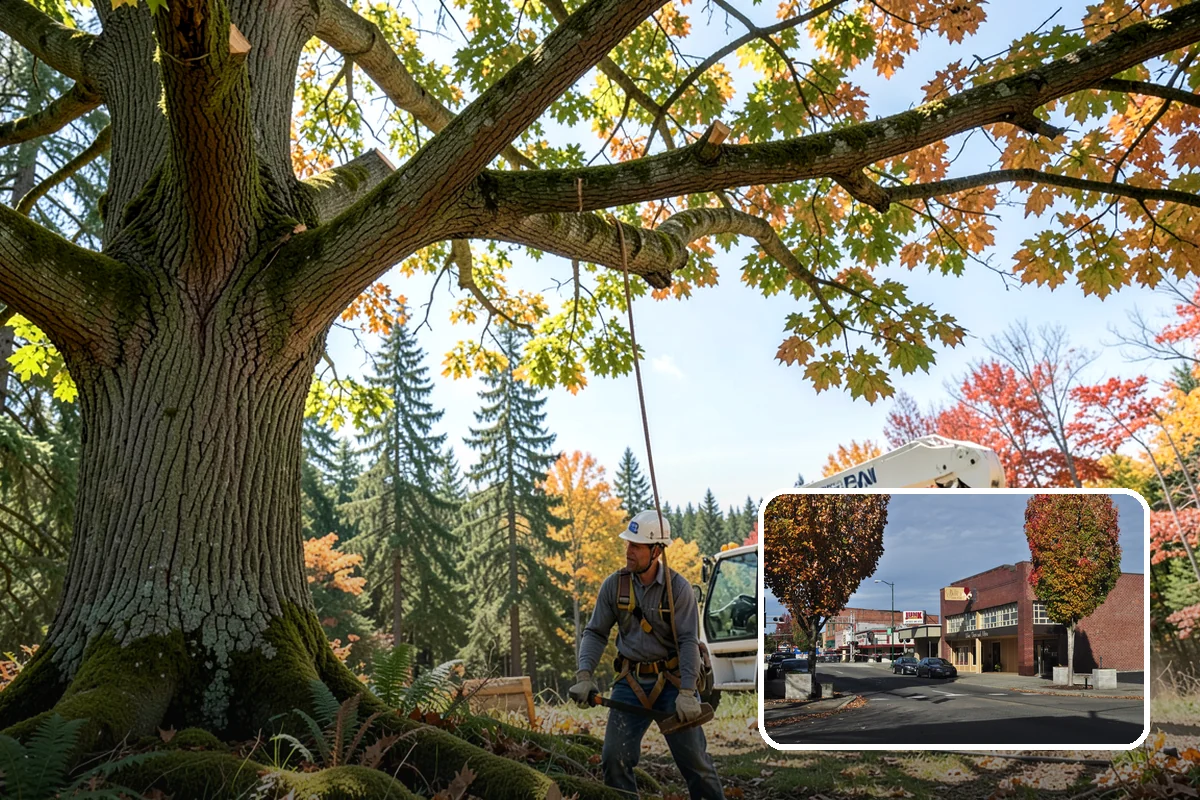
How confined-space tree removal works in Puyallup
When a tree cannot simply be felled, it comes down in pieces. The work is slower and more controlled than an open-lot removal. Here is the usual sequence.
- Assess the site: the lean of the tree, any decay, nearby structures, fences, and overhead lines.
- Set up the climb and rigging, choosing anchor points that can hold the load of each piece.
- Remove limbs and then the trunk in sections, lowering each piece on ropes instead of dropping it.
- Clear the debris and deal with the stump as agreed.
Why size matters on your lot
The city's street-tree inventory shows a median trunk diameter of 9.5 inches, with 0.0% of trees at 24 inches or wider. That inventory covers street trees only, so it does not describe the tree in your yard. If your tree is much larger than that, expect more sections, more rigging, and more time. A smaller trunk is often easier to lower in short pieces.
Why the housing mix matters
Single-family detached houses make up about 56% of Puyallup's housing, according to the Census ACS 2020-2024. That means many properties have side yards, fences, and a neighbor's roof a few feet away. Tell us about those neighbors. If the work could affect their property, it helps to let them know ahead of time.
Power lines and permits
We have not confirmed which electric utility serves your address. If any wires are near the tree, check your bill for the provider's name. Work near energized lines is a separate matter, and we will sort it out before anyone climbs. We also check with the city about any removal rules before work starts, because requirements can depend on the tree and the property.
For a free estimate, call or text 425-484-4442. An ISA Certified Arborist on staff can look at the tree with you, and we are licensed, bonded and insured.
Puyallup tree conditions at a glance
| USDA hardiness zone | 8b |
|---|---|
| Soils | 13% of land has hardpan or another restrictive layer within 40 in; most common series Puyallup; 47% well drained |
| High and strong wind episodes, 2005-2025 | 25 in the forecast zone |
| Electric utility | unconfirmed |
Tree removal rules in Puyallup
Significant tree protections do not apply to lots containing single-family, duplex, triplex or up to four-unit residential development unless the tree is in a critical area. A permit is required on such lots only if the tree is on the City's Heritage Tree register, or is within or associated with a critical area (wetland/buffer, steep slope, stream buffer, habitat area/greenbelt). Significant trees are regulated on commercial, industrial, institutional and multifamily (5+ units) property.
Regulated size: Healthy, living tree greater than 15 in DBH (black cottonwood and red alder not typically regulated unless in a critical area).
Official city source. Rules change; we confirm with the city before work starts.
Strongest wind events near Puyallup
- Oct 18, 2007: gusts to 62 mph
- Jan 6, 2019: gusts to 61 mph
- Feb 25, 2025: gusts to 60 mph
NOAA Storm Events, forecast zone that includes Puyallup, 2005-2025.
Most common street trees in Puyallup
- Flowering Pear14.6%
- Hornbeam9.4%
- Crabapple8.9%
- Linden7.3%
- Ash6.9%
- Green ash5.9%
Share of 812 trees in the city’s street-tree inventory; median trunk diameter 9.5 in, 0.0% at 24 in or wider.
Sources: Daymet daily weather (NASA/ORNL), NOAA Storm Events, USDA plant hardiness map 2023, NRCS soil survey, USGS elevation, WA DNR landslide inventory, USDA Forest Service aerial survey, WSDA, city tree assessments and street-tree inventories, SILVIS Lab, Arbor Day Foundation, and official city and utility pages.
Confined-space Tree Removal Serving Puyallup
Puyallup
Also serving Puyallup
- Ornamental Tree Planting in Puyallupat Washington Landscaping
- Park Tree Maintenance in Puyallupat Washington City Services
- Storm Wood Processing in Puyallupat Washington Firewood