Where Safety Meets Expert Tree Service.


Kenmore Reforestation Planting
Larger-scale planting to re-establish tree cover.
Maybe a cedar on your lot has thinned out and browned from the top, or a stand of trees came down and left a bare patch. Either way, the question is what to plant so the spot fills back in and stays healthy.
Reforestation planting is about matching species and placement to the site. Look at how much light the spot gets, how wet the soil stays, how steep the ground is, and what sits overhead. Those answers narrow the choices before any tree goes in the ground.
About Reforestation Planting in Kenmore
Reforestation planting helps homeowners restore tree cover on larger areas that have been cleared or degraded. This approach brings back the benefits of shade, privacy, and improved site ecology for your property. Our trained crews work to establish healthy trees that are well-suited to your specific location.
What Kenmore Reforestation Planting Includes
This service focuses on re-establishing broad canopy coverage rather than planting individual specimens in isolation. We match our methods carefully to the tree species chosen, current site conditions, and available access points. The goal is to create a resilient forest layer that supports long-term environmental health for your land.
Kenmore Reforestation Planting Process
Our team begins by assessing your site to select suitable species before preparing the soil and planting area. Each tree is planted at the correct depth with proper spacing, followed by mulching and watering in. We also provide guidance on establishment care to ensure these new trees thrive as they grow into a mature canopy.
Equipment We Use for Kenmore Reforestation Planting
The work utilizes digging tools for site preparation alongside equipment designed specifically for efficient planting operations. Soil amendments and fresh mulch are applied to support root development, while specialized watering gear ensures adequate moisture levels. Staking materials and personal protective equipment are used whenever necessary to secure young trees and keep crews safe.
Kenmore Reforestation Planting Safety & Best Practices
Before any ground is broken, we locate underground utilities to prevent damage during the digging process. We strictly select species suited to your site conditions to avoid future conflicts with structures or other vegetation. Planting at the proper depth and handling roots carefully are essential steps that protect both the new trees and our workers.
Signs You Need Reforestation Planting in Kenmore
You may need this service if you have areas of land where tree cover has been lost due to clearing or degradation. Signs include compacted soil, existing gaps in your canopy, or a desire to expand privacy and shade across a larger footprint. This project is ideal when the goal is to restore ecological balance rather than just adding isolated trees.
What Affects the Cost of Reforestation Planting in Kenmore
The overall investment depends on how accessible your site is for our crews and equipment teams. Costs are also influenced by soil conditions that might require amendments, the complexity of species selection, and whether staking or specialized watering gear is needed. These factors determine the resources required to successfully establish a new forest layer on your property.
Best Time of Year for Kenmore Reforestation Planting
In Washington’s Puget Sound climate, planting is generally best performed during dormant seasons to minimize stress on young trees. However, specific timing must always match the unique establishment requirements of the tree species you choose for your site. We will coordinate with you to schedule work when conditions are optimal for successful root growth and survival.
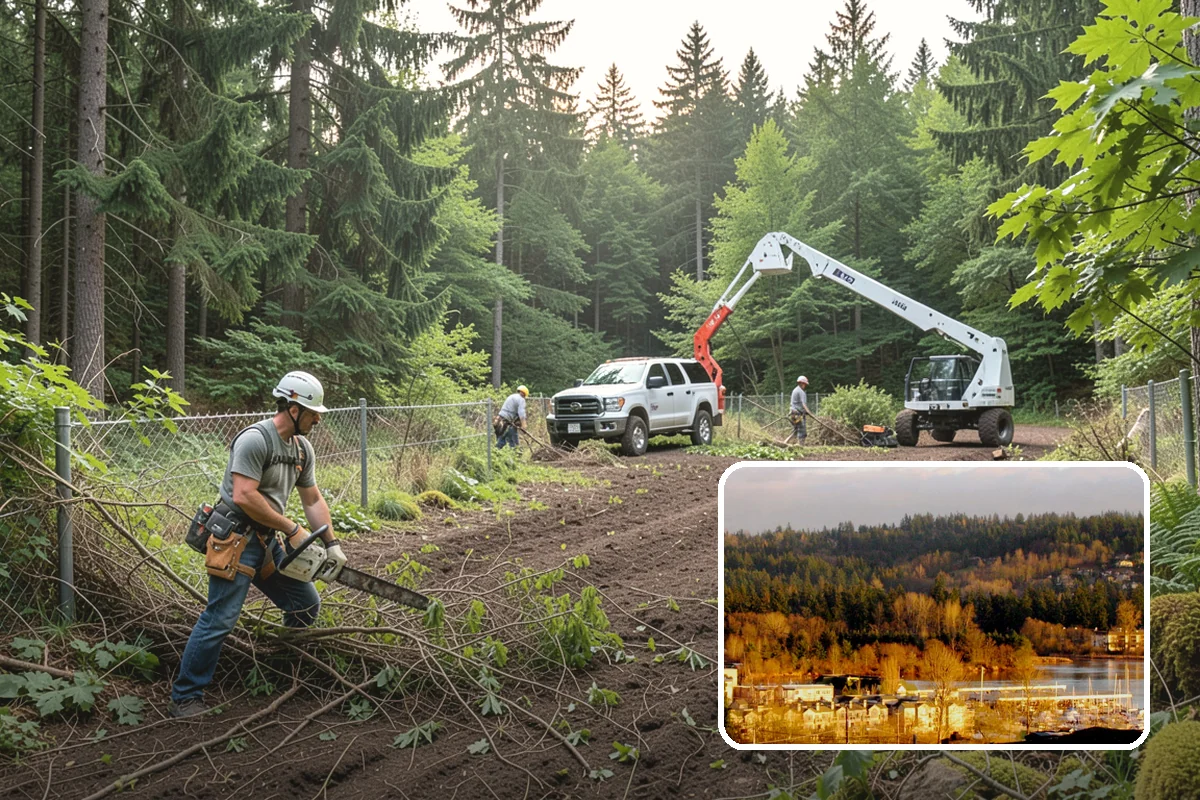
Reforestation planting in Kenmore: what shapes the plan
Start with the cause of the gap. If trees were removed or lost to storms, the soil may be compacted and the site open to sun and wind. If they declined slowly, the cause matters more, because replanting the same species into the same problem can repeat the loss.
Local forest data is a useful caution here. A 2021-2025 aerial forest health survey by the USDA Forest Service and WA DNR covered forest within 10 km of Kenmore. It mapped 141 acres of western redcedar in decline with no cause identified, meaning dieback where no single cause was found. That survey covers forest land, not yard or street trees, so it does not tell us about your cedars. It does suggest not assuming western redcedar is the automatic replacement everywhere. We look at the site first, and mixing species spreads the risk.
Slope and overhead lines
USGS elevation data shows Kenmore has some steep slopes, though fewer than the hilliest Puget Sound cities. On a sloped lot, we plant small, well-rooted stock and keep the ground covered after planting so soil stays in place while roots establish. Flat areas let you think more about spacing and future canopy.
Overhead wires change the species list. Utilities recommend trees with a mature height of 25 feet or less near distribution lines, and 10 feet of clearance is required, according to the WSU Extension Pacific Northwest Gardener's Handbook. A fir planted under a line will need constant pruning or removal later. A smaller species fits the space from the start.
Climate and the planting itself
The USDA map from 2023 places Kenmore in hardiness zone 9a, with parts of the city ranging from 8b to 9a. That is mild enough for a wide choice of species, so site conditions matter more than cold tolerance.
The work follows standard practice: clear competing weeds, plant at the correct depth with the root flare visible, mulch without piling it against the trunk, and water through the first dry seasons. Our ISA Certified Arborist can walk the site with you and recommend species before anything is ordered. If a city rule applies to work on your property, we check with the city before work starts.
Kenmore tree conditions at a glance
| USDA hardiness zone | 9a (8b to 9a across the city) |
|---|---|
| Soils | 51% of land has hardpan or another restrictive layer within 40 in; most common series Alderwood |
| Rain and snow falling October to April | 81% of the year’s total |
| Days that freeze at night and thaw by day | 30 a year |
Tree removal rules in Kenmore
Kenmore’s published rules don’t spell out clearly which removals need city approval. We check with the city before work starts.
Most common street trees in Kenmore
- Douglas-fir11.3%
- Eastern arborvitae9.8%
- Red alder8.4%
- Western red cedar7.4%
- Bigleaf maple5.1%
- Black cottonwood4.8%
Share of 12,435 trees in the city’s street-tree inventory; median trunk diameter 10.0 in, 14.0% at 24 in or wider.
Sources: Daymet daily weather (NASA/ORNL), NOAA Storm Events, USDA plant hardiness map 2023, NRCS soil survey, USGS elevation, WA DNR landslide inventory, USDA Forest Service aerial survey, WSDA, city tree assessments and street-tree inventories, SILVIS Lab, Arbor Day Foundation, and official city and utility pages.
Reforestation Planting Serving Kenmore
Kenmore

Reforestation planting in nearby areas
Also serving Kenmore
- Evergreen Tree Planting in Kenmoreat Washington Landscaping
- Median & Roundabout Landscaping in Kenmoreat Washington City Services