Where Safety Meets Expert Tree Service.


Carbonado Dead Tree Removal
The removal of dead trees that no longer have living tissue.
A tree that stays bare while its neighbors leaf out, or one with needles gone rust-red, is usually telling you something. Bark may be sloughing off in sheets, and small branches may snap easily instead of bending. Fungi at the base or woodpecker holes high in the trunk are other signs worth noting.
A dead tree is not a slow problem. Wood loses strength as it dries, and the tree can drop limbs or fall without much warning. If the tree stands near a house, driveway, power line or play area, it is worth having it looked at soon.
About Dead Tree Removal in Carbonado
If a tree on your property has lost all living tissue, our team is here to handle its safe removal for you. We understand that dealing with dead wood can feel overwhelming, so we are ready to help protect your home and landscape from falling hazards. Our goal is to clear the danger while respecting your space and peace of mind.
What Carbonado Dead Tree Removal Includes
This service focuses specifically on removing trees that no longer have living tissue inside them. It includes carefully taking down brittle branches or entire stems that pose a risk, as well as clearing away any debris left behind. We also work hard to stop pests from using the dead wood before they can spread disease to nearby healthy plants.
Carbonado Dead Tree Removal Process
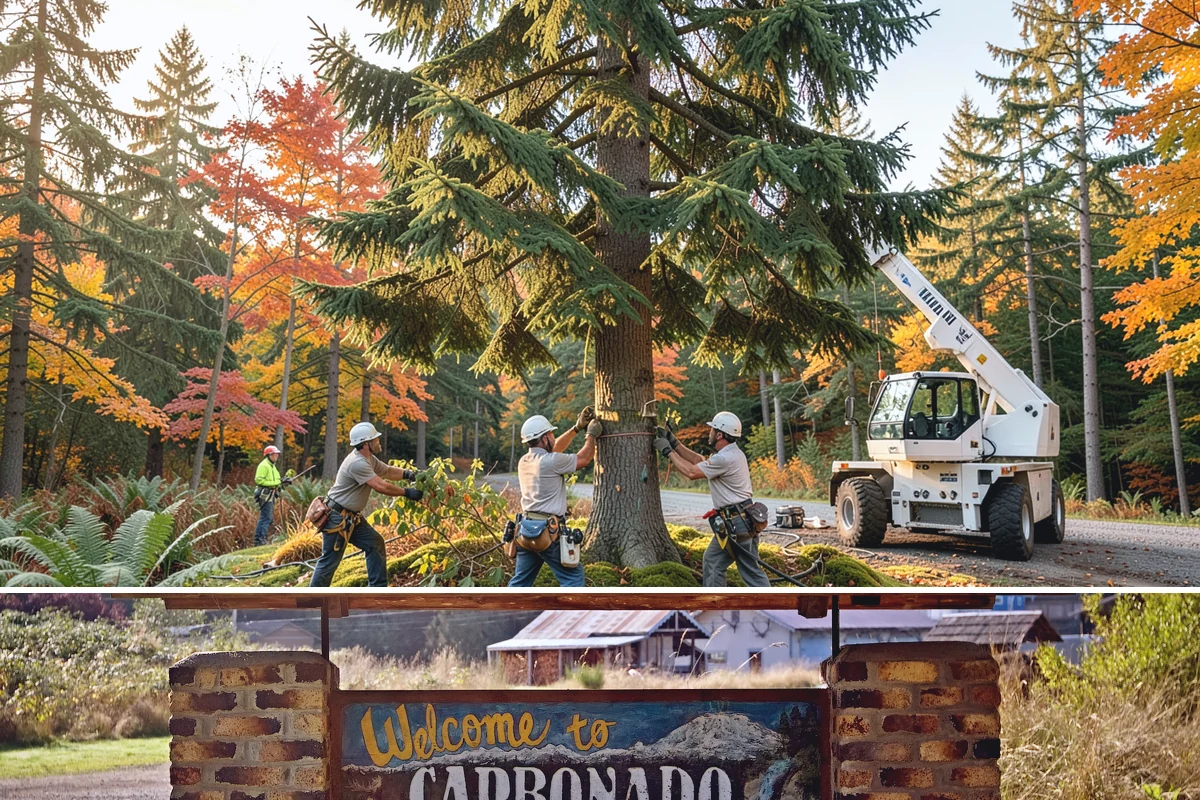
Our trained crews start with an on-site assessment to evaluate risks and establish safe drop zones around your property. Using recognized arboricultural standards, we rig limbs or fell the stem in a controlled sequence that matches the tree species and site conditions. Afterward, we process the wood, haul away debris, and perform final cleanup so your yard is left clear and tidy.
Equipment We Use for Carbonado Dead Tree Removal
We use professional chainsaws and climbing gear to navigate difficult branches safely while removing dead trees from various heights. Depending on the size of the job or access limitations, our crews may bring in aerial lifts or cranes to assist with heavy lifting. All tools are paired with ground protection measures to keep your landscaping safe during the workday.
Carbonado Dead Tree Removal Safety & Best Practices
Before any climbing begins, we inspect for hidden decay and structural defects that could cause an unexpected fall. We maintain clear drop zones and controlled paths so no one is in harm’s way when limbs or trunks come down. Our team also communicates constantly between climbers on the ground to ensure every step of the removal stays safe for everyone involved.
Signs You Need Dead Tree Removal in Carbonado
You likely need this service if you notice a tree that has become brittle, cracked, or shows signs it has completely died. These conditions create immediate falling hazards and often attract pests looking for easy food sources near your home. Identifying these issues early helps prevent damage to structures, utilities, and the rest of your garden before they spread further.
What Affects the Cost of Dead Tree Removal in Carbonado
The price depends on factors like how large the tree is and whether it sits close to power lines or buildings that limit our access. Hidden internal decay can add complexity to the job, requiring more careful planning than a straightforward removal would need. Additionally, requirements for wood disposal will influence the final cost based on what needs to be hauled away from your site.
Best Time of Year for Carbonado Dead Tree Removal
In our local climate, dead tree removal is possible year-round since we do not wait for specific seasons to begin work. However, many homeowners prefer scheduling this during drier periods when frozen ground conditions improve stability for equipment operating on slopes or uneven terrain. We can arrange a time that fits your schedule while ensuring the best working conditions for both our crew and your property.

Dead tree removal in Carbonado: causes and what to expect
Trees die for many reasons: root disease, drought stress, trunk injury, bark beetles, or a slow decline with no single cause. Knowing which one matters. Some problems stay in one tree. Others can move to neighbors.
What the local data suggests
Carbonado sits among a lot of forest. Satellite tree-canopy data (USFS/NLCD 2025) puts it among the most heavily treed Puget Sound cities we compared. If your lot borders woods, a dead tree may be one of many stressed trees nearby, so it helps to look at the whole edge of the property, not just the one you noticed.
A federal and state aerial survey (USDA Forest Service and WA DNR, 2021-2025) covered forest within 10 km of Carbonado. This is forest land, not yard trees, so it cannot tell us what is wrong with your tree. It does show what is affecting Douglas-fir nearby. The main damage mapped was bear damage on 8,076 acres. Root disease or bears affected another 1,139 acres, and Douglas-fir engraver beetle affected 878 acres. If you have a Douglas-fir with a dying top or thinning crown, those are reasonable things to rule in or out.
Storms matter too. A WA DNR Forest Health Program study of beetles after a Pacific Coast windstorm found Douglas-fir beetle catches rose in the second spring and stayed high for two years, with attacks on standing live trees following. After a big blow, keep an eye on nearby Douglas-firs for a couple of years, even if they look fine now.
How the work goes
We start by looking at the tree and what is around it: structures, lines, slope, and where it can safely fall or be lowered. Dead wood can be brittle, so crews often take a tree down in sections rather than felling it whole. Climbing or rigging may be needed where space is tight. Afterward, the wood can be hauled off or cut up, and the stump can be ground if you want it gone.
Carbonado's published tree rules do not clearly say which removals need city approval, so we check with the city before work starts. Call or text 425-484-4442 for a free estimate, and our ISA Certified Arborist can assess the tree.
Carbonado tree conditions at a glance
| USDA hardiness zone | 8b |
|---|---|
| Tree canopy | Among the most heavily treed Puget Sound cities (satellite data) |
| Slopes | Some steep slopes |
| Soils | 0% of land has hardpan or another restrictive layer within 40 in; most common series Barneston; 100% well drained |
| High and strong wind episodes, 2005-2025 | 40 in the forecast zone |
| Electric utility | Puget Sound Energy (PSE) |
Tree removal rules in Carbonado
Carbonado’s published rules don’t spell out clearly which removals need city approval. We check with the city before work starts.
Trees near the power line to your house
Puget Sound Energy (PSE): Service line (wire from PSE pole to home or meter pole): PSE does not trim it; homeowner/private arborist trims.
PSE performs a safety disconnection so the homeowner or private tree trimmer/arborist can work; Call at least 5 business days ahead to check crew availability and potential charges.
Safety disconnect: 1-888-321-7779 (5+ business days ahead). Utility page.
Any fee for a disconnect is set by the utility.
Strongest wind events near Carbonado
- Dec 17, 2010: gusts to 72 mph
- Feb 1, 2017: gusts to 70 mph
- Feb 7, 2012: gusts to 70 mph
NOAA Storm Events, forecast zone that includes Carbonado, 2005-2025.
Sources: Daymet daily weather (NASA/ORNL), NOAA Storm Events, USDA plant hardiness map 2023, NRCS soil survey, USGS elevation, WA DNR landslide inventory, USDA Forest Service aerial survey, WSDA, city tree assessments and street-tree inventories, SILVIS Lab, Arbor Day Foundation, and official city and utility pages.
Dead Tree Removal Serving Carbonado
Carbonado

Dead tree removal in nearby areas
Also serving Carbonado
- Raised Garden Bed Construction in Carbonadoat Washington Landscaping
- Tree Inventory in Carbonadoat Washington City Services
- Customer Tree Processing in Carbonadoat Washington Firewood