Where Safety Meets Expert Tree Service.

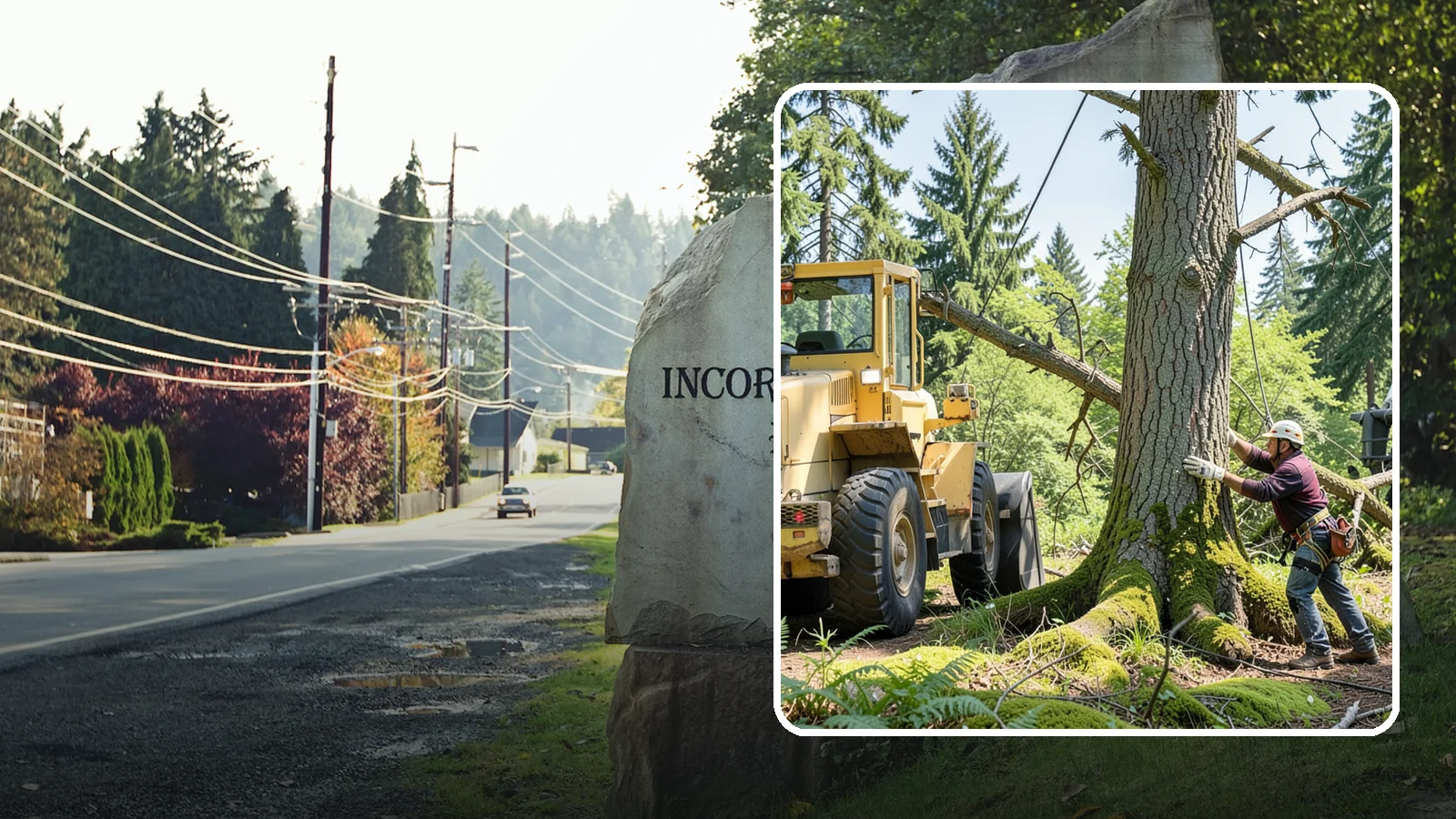
Wilkeson Hanging Limb Removal
The removal of broken, suspended limbs.
You may see a broken branch stuck in the crown, a limb split and sagging from the trunk, or a dead branch caught on others above your driveway or roof. Hanging limbs rarely stay put. A gust, the weight of rain, or a bit of ice can bring them down without warning.
Keep people, cars and pets out from under the tree until it is checked. Take a photo from a safe distance and note where the limb hangs. That helps us judge how it is held and how to take it down safely.
About Hanging Limb Removal in Wilkeson
If severe weather has left broken branches dangling from your trees, our team is ready to help you restore safety quickly. We specialize in removing these suspended limbs so you can regain access to your property without worry. This service brings peace of mind after a storm by addressing immediate hazards right away.
What Wilkeson Hanging Limb Removal Includes
Hanging limb removal focuses specifically on clearing broken branches that remain attached or are partially detached from the tree. Our trained crews work according to recognized arboricultural standards, using methods tailored to your specific tree species and site conditions. The goal is simply to eliminate the danger posed by hanging debris efficiently.
Wilkeson Hanging Limb Removal Process
We begin by assessing the damage and identifying any immediate hazards before making the area safe for our crew. Once secure, we carefully remove both the hanging limbs and downed material while processing and hauling away all debris. If documentation of your property’s condition is needed, we will handle that as part of our work.
Equipment We Use for Wilkeson Hanging Limb Removal
Our crews utilize chainsaws to cut through wood and rigging gear to manage heavy loads safely during removal. Depending on the size of the tree or location of the limb, an aerial lift or crane may be brought in for access. We also bring a chipper and hauling equipment to clear your property quickly after the limbs are downed.
Wilkeson Hanging Limb Removal Safety & Best Practices
Storm-damaged trees should always be treated as unstable because they remain under significant load until fully removed. Our team stays alert for hidden utility lines that might have been knocked down or buried during the storm. We release tension carefully on bent material and keep all bystanders clear to ensure a safe work environment.
Signs You Need Hanging Limb Removal in Wilkeson
You likely need this service if you see branches hanging precariously from trees after recent high winds or heavy rain. Hidden cracks in wood or signs of partial failure often indicate that a limb is about to drop unexpectedly. If access to your yard feels blocked by debris, clearing these hazards helps prevent secondary failures later on.
What Affects the Cost of Hanging Limb Removal in Wilkeson
The price for this work depends heavily on the species of tree you have and how difficult it is to reach the broken limbs. Site conditions play a major role, especially if recent storms have limited vehicle or foot access around your property. Additionally, removing limbs that are pinned under tension requires more careful planning than cutting down healthy branches.
Best Time of Year for Wilkeson Hanging Limb Removal
This storm response service is performed immediately following severe weather events when hanging branches pose an active threat to people and homes. Waiting too long can increase the risk of sudden failure as stored energy builds up within damaged wood. We aim to be on-site quickly after a storm passes to help homeowners recover from the immediate aftermath.
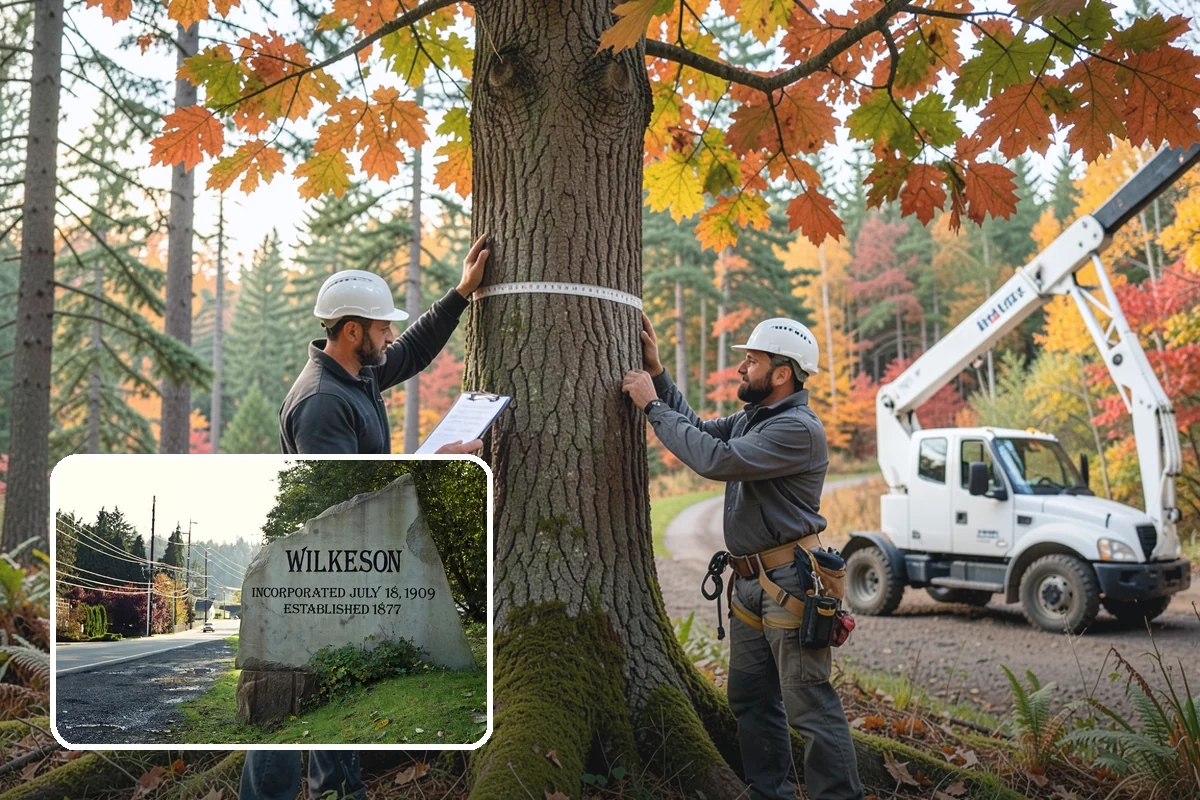
Hanging limbs and storm wind in Wilkeson
A hanging limb is a branch that has broken or split but is still attached, either to its own tree or to a neighboring one. Common causes are wind, ice load, old wounds, decay and poor earlier pruning. The limb may look secure, but the wood holding it is often torn and under strain.
Local weather makes this worth acting on. The National Weather Service forecast zone that includes Wilkeson recorded 40 high and strong wind episodes between 2005 and 2025. It also recorded 3 ice storm episodes in that period. These figures cover the whole zone, not one yard, but they show that wind and ice loading are repeat events here. A limb already hanging may not survive the next one, so waiting for the next storm is a poor plan.
Past pruning matters too. Washington DNR's Tree Link guidance, in its piece on factors contributing to tree failure, says topping, lion's-tailing and wind-sailing create defects that predispose trees to storm damage. If a tree has been cut that way, the weak regrowth or stripped branches may be the reason limbs keep breaking. We would look for that while we are up there, and we do not recommend topping as a fix.
Wilkeson falls in USDA hardiness zone 8b, according to the 2023 USDA map. That is a general climate measure, not a tree health reading, so it does not tell us whether a given limb is sound. We judge each one by what we see in the wood and the attachment.
For the work itself, the first step is to assess how the limb is loaded and what lies below it. Where it is safe, the limb is removed in controlled sections or lowered on rope, rather than cut loose to drop. Cuts are made just outside the branch collar, following standard ISA and ANSI A300 practice, so the tree can seal the wound as well as it can. Broken stubs and torn bark are cleaned up, and we point out other defects we notice. If the tree is on city or shared land, or if the work might extend past the limb itself, we check with the city before work starts.
To get a free estimate, call or text 425-484-4442 with a photo and the location of the limb.
Wilkeson tree conditions at a glance
| High and strong wind episodes, 2005-2025 | 40 in the forecast zone |
|---|---|
| Ice storm episodes, 2005-2025 | 3 in the forecast zone |
| Average snowfall | 10.4 in a season (approximate) |
| Soils | 37% of land has hardpan or another restrictive layer within 40 in; most common series Indianola; 61% well drained |
| Rain and snow falling October to April | 79% of the year’s total |
| Electric utility | Puget Sound Energy (PSE) |
Tree removal rules in Wilkeson
Wilkeson’s published rules don’t spell out clearly which removals need city approval. We check with the city before work starts.
Trees near the power line to your house
Puget Sound Energy (PSE): Service line (wire from PSE pole to home or meter pole): PSE does not trim it; homeowner/private arborist trims.
PSE performs a safety disconnection so the homeowner or private tree trimmer/arborist can work; Call at least 5 business days ahead to check crew availability and potential charges.
Safety disconnect: 1-888-321-7779 (5+ business days ahead). Utility page.
Any fee for a disconnect is set by the utility.
Strongest wind events near Wilkeson
- Dec 17, 2010: gusts to 72 mph
- Feb 1, 2017: gusts to 70 mph
- Feb 7, 2012: gusts to 70 mph
NOAA Storm Events, forecast zone that includes Wilkeson, 2005-2025.
Sources: Daymet daily weather (NASA/ORNL), NOAA Storm Events, USDA plant hardiness map 2023, NRCS soil survey, USGS elevation, WA DNR landslide inventory, USDA Forest Service aerial survey, WSDA, city tree assessments and street-tree inventories, SILVIS Lab, Arbor Day Foundation, and official city and utility pages.
Hanging Limb Removal Serving Wilkeson
Wilkeson
Hanging limb removal in nearby areas
Also serving Wilkeson
- Disaster Response Roofing in Wilkesonat Washington Roofing
- Foundation Crack Injection in Wilkesonat Washington Construction
- Roof Snow Removal in Wilkesonat Washington Landscaping
- Winter Storm Cleanup in Wilkesonat Washington Snow Removal