Where Safety Meets Expert Tree Service.


Kenmore Sidewalk Clearance Pruning
Pruning to provide clearance over walkways.
You may notice it when you walk the dog or push a stroller. Branches brush your shoulder, a low limb forces you to duck, or a neighbor has to step into the street to get around your hedge. Those are the signs that a tree or shrub has grown into the sidewalk space.
Sidewalk clearance pruning removes or shortens the growth that hangs over the walkway, so people can pass upright and see ahead. It is usually a small, planned job, and it is easier to do before limbs get heavy and thick.
About Sidewalk Clearance Pruning in Kenmore
Sidewalk clearance pruning helps keep your pedestrian paths safe and unobstructed by managing tree branches near walkways. This service is designed for homeowners who want clear sightlines while maintaining the health of their trees. We work with you to ensure that people can move freely without worrying about overhead limbs.
What Kenmore Sidewalk Clearance Pruning Includes
This specific type of pruning focuses on providing adequate clearance over sidewalks and other walkable areas. Our trained crews follow recognized arboricultural standards, selecting methods that match your tree species and site conditions. The goal is to keep paths open while preserving the natural structure and beauty of each tree.
Kenmore Sidewalk Clearance Pruning Process
We begin by assessing the current canopy condition and defining clear pruning objectives for your property. Careful cuts are made at proper points without over-pruning, ensuring minimal stress on the trees. Afterward, we lower and process all cut material before thoroughly cleaning up the work area to leave everything tidy.
Equipment We Use for Kenmore Sidewalk Clearance Pruning
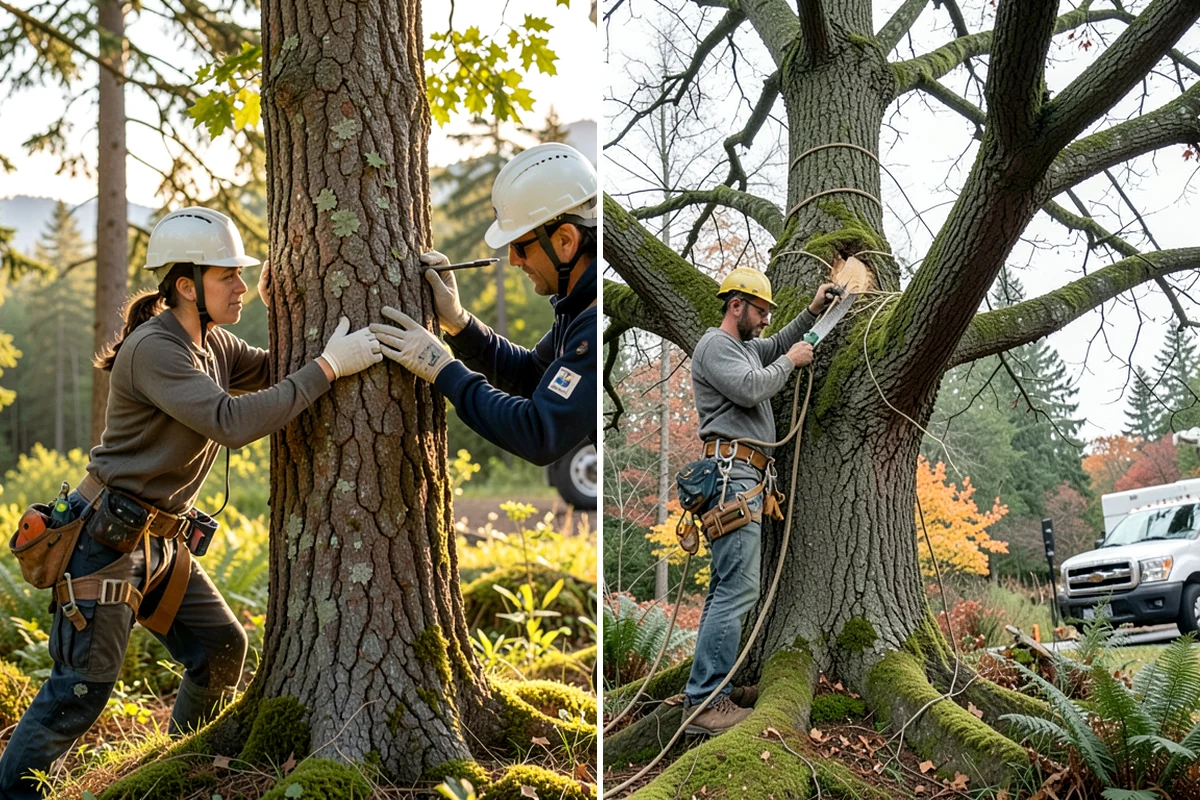
Our crews use a variety of tools including hand saws, pole saws, chainsaws, and wood chippers depending on the job size. When branches are high or hard to reach, we utilize climbing gear, rigging equipment, or aerial lifts as needed. All team members wear necessary personal protective equipment while operating these machines safely around your home.
Kenmore Sidewalk Clearance Pruning Safety & Best Practices
We strictly follow recognized pruning standards to avoid making harmful cuts that could weaken a tree’s structure. Our approach limits removal to healthy amounts of live tissue and keeps an eye out for unstable limbs or overhead power lines. When working at height, we always use proper fall protection to ensure the safety of our crew on your property.
Signs You Need Sidewalk Clearance Pruning in Kenmore
You may need this service if you notice branches hanging low over sidewalks where pedestrians walk daily. Deadwood in weak unions or interference with nearby structures are also common reasons to schedule a clearance pruning session. If you feel that sightlines along your path are blocked by dense foliage, it is time to contact us for an assessment.
What Affects the Cost of Sidewalk Clearance Pruning in Kenmore
The final cost depends on the specific tree species and their overall canopy condition at the site. Access requirements such as using climbing gear or aerial lifts will also influence how much work is needed. Additionally, the volume of material that must be processed through our wood chipper plays a role in the total price.
Best Time of Year for Kenmore Sidewalk Clearance Pruning
While we follow recognized arboricultural standards matched to your specific site conditions, it is best to avoid dormant seasons for certain Pacific Northwest species. We aim to schedule this work when tree health will not be stressed by seasonal changes or weather patterns. Our team will advise you on the ideal time based on the unique needs of each tree in your yard.

Sidewalk clearance pruning in Kenmore: causes and local factors
Branches reach over a sidewalk because they grow toward open light. A tree beside a path extends limbs outward, and each year those limbs get longer and heavier. Weight pulls them lower, and wet weather adds to the sag. A limb that cleared your head last summer may not clear it now.
What Kenmore's trees tell us
Kenmore's street-tree inventory lists 12,435 trees. The most common are Douglas-fir at 11.3%, Eastern arborvitae at 9.8%, Red alder at 8.4%, Western red cedar at 7.4% and Bigleaf maple at 5.1%. That inventory covers city street trees, not every yard tree, so it does not describe the trees on your property. It does show what you are likely to see along local sidewalks, and the mix matters for pruning. Arborvitae and cedar tend to carry dense, drooping foliage low on the tree. Bigleaf maple and red alder can push out long, fast limbs that reach across a walkway.
Kenmore sits in USDA hardiness zone 9a, with parts of the city ranging from 8b to 9a, according to the 2023 USDA map. That is a mild range, and mild conditions allow plants to keep growing for much of the year. Clearance is therefore not a one-time fix, and a walkway that was clear can close in again.
How the work is done
Under ISA and ANSI A300 style practice, we cut back to a branch union or a lateral branch large enough to take over, rather than leaving stubs or shearing everything flat. We take out the smallest amount of live growth that achieves the clearance. Large cuts are avoided where we can, because big wounds are harder for a tree to close. We do not recommend topping.
A common target is clear space over the walkway, with extra height where taller people or strollers pass. Hedges and shrubs can be cut back to the property line so the full width of the sidewalk is usable.
Kenmore's published tree rules do not clearly say which removals need city approval. If a job turns into taking a tree out, we check with the city before work starts. Our ISA Certified Arborist can look at the trees along your walkway and tell you what is practical. Estimates are free.
Kenmore tree conditions at a glance
| USDA hardiness zone | 9a (8b to 9a across the city) |
|---|---|
| Rain and snow falling October to April | 81% of the year’s total |
| Tree canopy | Among the most heavily treed Puget Sound cities (satellite data) |
| Days that freeze at night and thaw by day | 30 a year |
| Electric utility | Puget Sound Energy (PSE) |
Trees near the power line to your house
Puget Sound Energy (PSE): Service line (wire from PSE pole to home or meter pole): PSE does not trim it; homeowner/private arborist trims.
PSE performs a safety disconnection so the homeowner or private tree trimmer/arborist can work; Call at least 5 business days ahead to check crew availability and potential charges.
Safety disconnect: 1-888-321-7779 (5+ business days ahead). Utility page.
Any fee for a disconnect is set by the utility.
Most common street trees in Kenmore
- Douglas-fir11.3%
- Eastern arborvitae9.8%
- Red alder8.4%
- Western red cedar7.4%
- Bigleaf maple5.1%
- Black cottonwood4.8%
Share of 12,435 trees in the city’s street-tree inventory; median trunk diameter 10.0 in, 14.0% at 24 in or wider.
Sources: Daymet daily weather (NASA/ORNL), NOAA Storm Events, USDA plant hardiness map 2023, NRCS soil survey, USGS elevation, WA DNR landslide inventory, USDA Forest Service aerial survey, WSDA, city tree assessments and street-tree inventories, SILVIS Lab, Arbor Day Foundation, and official city and utility pages.
Sidewalk Clearance Pruning Serving Kenmore
Kenmore

Sidewalk clearance pruning in nearby areas
Also serving Kenmore
- Spruce Pruning in Kenmoreat Washington Landscaping
- Roof Moss Removal in Kenmoreat Washington Roofing
- Street Tree Pruning in Kenmoreat Washington City Services