Where Safety Meets Expert Tree Service.


Burlington Emergency Storm Cleanup
The rapid cleanup of tree damage after a storm.
A limb is down across the driveway, a crown is hanging in a neighboring branch, or the lawn is covered in broken wood after a windstorm. Any of these can make a yard feel unsafe to walk through, and it is hard to tell which pieces are the real danger.
Start by staying clear of anything touching or near a power line, and keep people and pets away from hanging or split limbs. Take photos from a safe distance. Note what is on the ground, what is still overhead, and what the debris is leaning on. That record helps with planning the work and with an insurance claim.
About Emergency Storm Cleanup in Burlington
When severe weather hits our area, emergency storm cleanup helps restore safety and access quickly after a tree falls or breaks. This rapid response is designed for property owners who need debris removed efficiently following a storm event. Our trained crews are ready to assist you in recovering from the damage caused by wind, rain, or other harsh conditions.
What Burlington Emergency Storm Cleanup Includes
Emergency storm cleanup focuses on clearing downed material and hanging limbs to prevent secondary failures around your home. We match our removal methods carefully to the specific tree species found at your site and current access limitations. This service ensures that dangerous debris is processed and hauled away so you can move forward with repairs.
Burlington Emergency Storm Cleanup Process
Our typical approach begins by assessing immediate hazards and making the area safe for everyone involved. Crews then remove broken branches and fallen trunks while documenting any necessary damage details for your records. Finally, we process the wood at our facility or on-site before hauling it away to leave your property clear.
Equipment We Use for Burlington Emergency Storm Cleanup
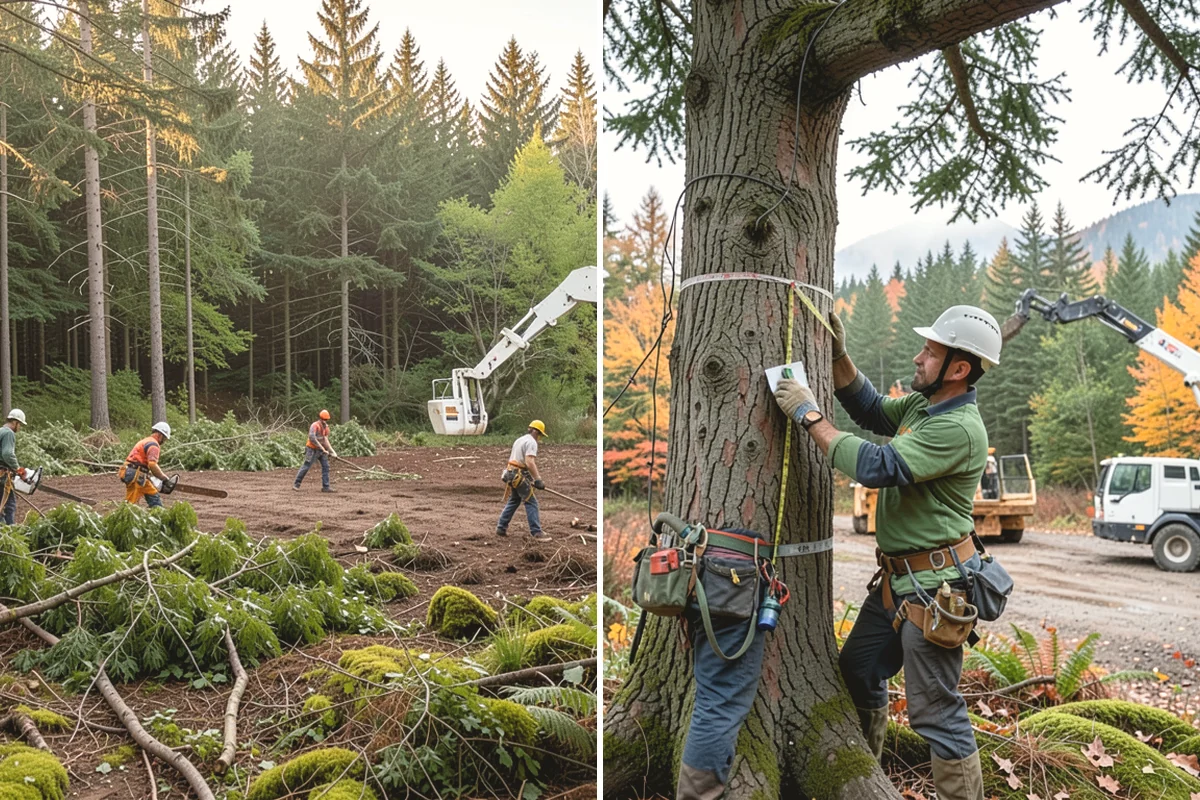
We utilize professional chainsaws, rigging gear, and personal protective equipment to handle storm-damaged trees safely. Depending on the size of the job and site access needs, an aerial lift or crane may be brought in as required. Additional tools like a chipper are used to break down wood before it is loaded onto hauling trucks for removal.
Burlington Emergency Storm Cleanup Safety & Best Practices
Storm-damaged trees often remain unstable under load, so we treat every situation with caution until fully secured. Our crews watch closely for hidden utility lines and release tension carefully on bent or pinned material during removal. We also keep bystanders clear of the work zone to ensure everyone stays safe while debris is cleared efficiently.
Signs You Need Emergency Storm Cleanup in Burlington
You may need this service if you see trees under stored tension, downed power lines, or cracks that have partially failed in your yard. Limited access after a storm often signals the need for professional help to navigate safely around hazardous conditions. If hanging limbs threaten structures or block driveways following severe weather, our cleanup team is prepared to respond immediately.
What Affects the Cost of Emergency Storm Cleanup in Burlington
The final cost depends on factors like tree species and specific site conditions where the damage occurred. Access limitations created by fallen debris can also influence how much time and equipment are needed for removal. Additionally, the total volume of debris requiring processing and haul-away will play a significant role in pricing your project.
Best Time of Year for Burlington Emergency Storm Cleanup
This service is available year-round to address severe weather events that occur throughout the Puget Sound region rather than just one season. Whether it happens after an unexpected winter storm or a summer thunderstorm, we are ready to deploy crews when you need them most. There is no specific seasonal restriction on our availability for emergency cleanup needs during bad weather.

Storm cleanup in Burlington: what drives the work
Storm damage comes from wind loading a tree beyond what its wood and roots can hold. Trees with decay, old wounds, co-dominant stems or soil that has stayed wet are the ones that tend to shed limbs or tip. Damage is often split between what has already fallen and what is now weak but still standing.
Wind is a real factor here. A forecast zone that includes Burlington logged 33 high and strong wind episodes between 2005 and 2025. That figure covers the whole zone, not this street or your trees. It does mean a damaged tree may face another gust before it is dealt with, so overhead hazards should be handled early rather than left to see what happens.
Rain matters less than you might expect for timing. Daymet data show about 3.7 days a year in Burlington with an inch or more of rain, so very heavy rain days are uncommon. When one comes alongside wind, saturated soil can loosen roots, so a leaning tree after such a storm deserves a close look.
How the cleanup works
The first step is an assessment. We look for hanging limbs, cracked stems, lifted root plates and tension in wood that is pinned under other wood. Pinned or bent material can spring when cut, so the order of cuts matters. Hazard limbs are removed first, then fallen trunks are sectioned and cleared. Broken branches are pruned back to proper cuts outside the branch collar where the tree is worth keeping, following standard ANSI A300 practice. We do not top trees.
If a line is involved, the work waits. We could not find a published storm-debris policy from Puget Sound Energy, so call the utility about lines before anyone approaches. Whether a tree can be removed may also depend on city rules, and we check with the city before work starts where it is unclear.
Skagit County is inside the WSDA apple maggot quarantine. Homegrown fruit and yard waste may not be moved out of the quarantine area into pest-free areas, so haul-off of debris needs to stay within that rule.
For an estimate, call or text 425-484-4442. Estimates are free.
Burlington tree conditions at a glance
| High and strong wind episodes, 2005-2025 | 33 in the forecast zone |
|---|---|
| Average snowfall | 8.6 in a season |
| Soils | 4% of land has hardpan or another restrictive layer within 40 in; most common series Field |
| Rain and snow falling October to April | 78% of the year’s total |
| Electric utility | Puget Sound Energy (PSE) |
Tree removal rules in Burlington
Significant trees may not be removed without prior authorization from the department, BUT the significant-tree rules do not apply to trees within the boundaries of an existing landscaped yard associated with an individual dwelling (except redevelopment projects), nor to construction of a single detached dwelling, duplex or small multiunit building or land divisions of four lots or less. So ordinary removal in an existing single-family yard needs no tree approval outside critical areas.
Regulated size: 6 inches DBH (multi-stem: any stem at least 4 in. measured 6 in. from the trunk joint).
Official city source. Rules change; we confirm with the city before work starts.
Trees near the power line to your house
Puget Sound Energy (PSE): Service line (wire from PSE pole to home or meter pole): PSE does not trim it; homeowner/private arborist trims.
PSE performs a safety disconnection so the homeowner or private tree trimmer/arborist can work; Call at least 5 business days ahead to check crew availability and potential charges.
Safety disconnect: 1-888-321-7779 (5+ business days ahead). Utility page.
Any fee for a disconnect is set by the utility.
Strongest wind events near Burlington
- Dec 14, 2006: gusts to 85 mph
- Feb 3, 2006: gusts to 78 mph
- Nov 15, 2006: gusts to 74 mph
NOAA Storm Events, forecast zone that includes Burlington, 2005-2025.
Sources: Daymet daily weather (NASA/ORNL), NOAA Storm Events, USDA plant hardiness map 2023, NRCS soil survey, USGS elevation, WA DNR landslide inventory, USDA Forest Service aerial survey, WSDA, city tree assessments and street-tree inventories, SILVIS Lab, Arbor Day Foundation, and official city and utility pages.
Emergency Storm Cleanup Serving Burlington
Burlington
Emergency storm cleanup in nearby areas
Also serving Burlington
- Insurance Claim Assistance in Burlingtonat Washington Roofing
- House Leveling in Burlingtonat Washington Construction
- Bed Preparation in Burlingtonat Washington Landscaping
- Fire Lane Clearing in Burlingtonat Washington Snow Removal