Where Safety Meets Expert Tree Service.

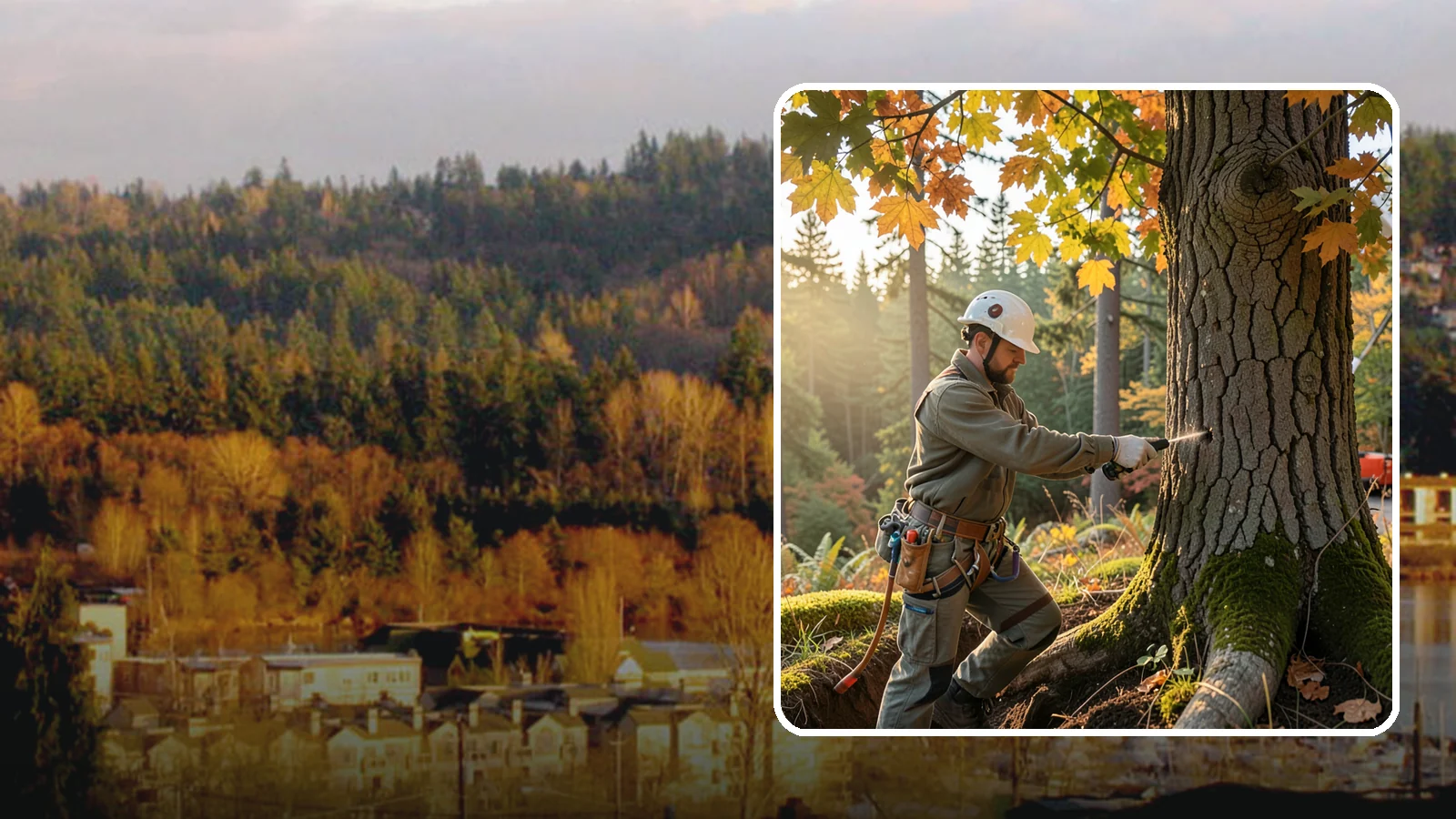
Kenmore Deep Root Fertilization
The injection of nutrients into the root zone.
Is deep root fertilization worth doing for a Kenmore tree? Sometimes. It makes sense when a soil test or a visible problem, such as pale leaves, short new growth or thinning crowns, points to a nutrient shortfall. It does not make sense as an automatic yearly routine for every tree.
The work places liquid or soluble nutrients into the upper soil where most fine roots grow. Before any product goes in, the first step is to learn what the soil already holds and what the tree actually needs.
About Deep Root Fertilization in Kenmore
Deep root fertilization is a targeted approach to tree health care that delivers essential nutrients directly into your landscape’s foundation. This service helps valued trees thrive by addressing issues like nutrient-poor or compacted soils before they become serious problems. It is designed for homeowners who want long-term stability and vitality in their existing canopy.
What Kenmore Deep Root Fertilization Includes
The core of this treatment involves injecting specialized nutrients deep into the root zone where your tree can access them most effectively. Our trained crews match specific methods to the unique species, site conditions, and access points around each individual tree. This process supports overall health by improving soil quality while catching early signs of decline before they escalate.
Kenmore Deep Root Fertilization Process
We begin with a thorough inspection of the tree and its surrounding environment to identify contributing factors such as pests or disease history. Based on these findings, we recommend and apply appropriate treatments tailored to your specific site conditions. Every step is documented carefully so you can track progress and plan for necessary follow-up care later on.
Equipment We Use for Kenmore Deep Root Fertilization
Our crews utilize diagnostic tools and soil probes to assess the condition of the ground before starting work. We bring along injection equipment designed to deliver nutrients without damaging roots or trunks, alongside air excavation tools when needed for access. All team members wear personal protective equipment to ensure a safe environment during application.
Kenmore Deep Root Fertilization Safety & Best Practices
Safety is paramount as we strictly follow label guidelines and application instructions for any products used on your property. We take extra care to protect surrounding plantings and the soil structure while avoiding damage to roots or trunks during injection. Accurate documentation of site conditions ensures that our work remains safe and effective throughout the entire process.
Signs You Need Deep Root Fertilization in Kenmore
You may need this service if you notice trees struggling in areas where the ground has become compacted over time. Other indicators include decline caused by past construction, grade changes, girdling roots, or an inability to support healthy growth due to poor soil quality. Recognizing these issues early allows us to intervene and restore your landscape’s natural balance effectively.
What Affects the Cost of Deep Root Fertilization in Kenmore
The investment for deep root fertilization varies based on the size of each tree requiring treatment. Accessibility matters significantly, as difficult-to-reach injection points or complex site conditions like steep grades can influence pricing. Ultimately, we tailor our approach to ensure you receive fair value that matches your specific landscape needs and budget constraints.
Best Time of Year for Kenmore Deep Root Fertilization
While this service is available year-round in the Puget Sound region, weather patterns do affect how quickly we can complete certain tasks. During wetter seasons, we may need to use air excavation tools first to clear access before injecting nutrients into the root zone. Planning your project outside of heavy rain periods often allows for smoother execution and better results without delays.
Deep root fertilization in Kenmore: soil, rain and timing
Start with the soil under the tree
The NRCS soil survey says 51% of Kenmore's land has a hard or restrictive layer, such as glacial hardpan, within 40 inches of the surface. The most common soil series is Alderwood. That is citywide survey data, not a reading of your yard. Still, it is a good reason to check how deep roots can go on your lot. Where a hard layer sits close to the surface, roots spread sideways in the upper soil. That is the zone fertilizer injection reaches, but it is also a zone that can stay soggy or dry out fast.
Rain shapes when to apply
Daymet data for 2005 to 2025 shows 81% of Kenmore's yearly rain and snow falls from October to April. Nutrients applied into saturated soil can move past the roots or run off. Applying when soil is workable but not waterlogged usually gives roots a better chance to take them up. We pick timing based on current soil moisture, not a fixed date.
Water matters as much as feed
With most precipitation arriving in the cool months, summers can be dry. WSU HortSense notes that cedars may need extra irrigation during summer drought to reduce flagging, the browning of individual branches. Fertilizer will not fix drought stress, and feeding a dry, stressed tree can add to the problem. If your cedar is flagging, look at watering first.
Kenmore sits in USDA hardiness zone 9a, with parts of the city ranging from 8b to 9a, according to the 2023 USDA map. That figure describes winter cold, not soil nutrition, so it will not tell you what a tree needs.
- Pale or yellowing foliage
- Unusually short annual shoot growth
- Thin crowns with no sign of pests or drought
If you see any of these, call or text 425-484-4442. Our ISA Certified Arborist can look at the tree, the soil and the watering history before recommending anything.
Kenmore tree conditions at a glance
| USDA hardiness zone | 9a (8b to 9a across the city) |
|---|---|
| Soils | 51% of land has hardpan or another restrictive layer within 40 in; most common series Alderwood |
| Rain and snow falling October to April | 81% of the year’s total |
| Days with 0.1 in or more of rain | 108 a year |
| Tree canopy | Among the most heavily treed Puget Sound cities (satellite data) |
| Days that freeze at night and thaw by day | 30 a year |
Most common street trees in Kenmore
- Douglas-fir11.3%
- Eastern arborvitae9.8%
- Red alder8.4%
- Western red cedar7.4%
- Bigleaf maple5.1%
- Black cottonwood4.8%
Share of 12,435 trees in the city’s street-tree inventory; median trunk diameter 10.0 in, 14.0% at 24 in or wider.
Tree health near Kenmore
Spongy moth (WSDA 2020): WSDA trap detection(s): 2 catch record(s) listed (per-trap counts not given).
Spongy moth (WSDA 2016): WSDA trap detection(s): 1 moth(s) in 1 trap catch record(s).
- Decline, cause not identified141 ac
Forest damage mapped from the air within 10 km of Kenmore, 2021-2025 (USDA Forest Service and WA DNR). This covers forest land, not street or yard trees. “Decline, cause not identified” is dieback with no single cause found.
Sources: Daymet daily weather (NASA/ORNL), NOAA Storm Events, USDA plant hardiness map 2023, NRCS soil survey, USGS elevation, WA DNR landslide inventory, USDA Forest Service aerial survey, WSDA, city tree assessments and street-tree inventories, SILVIS Lab, Arbor Day Foundation, and official city and utility pages.
Deep Root Fertilization Serving Kenmore
Kenmore
Deep root fertilization in nearby areas
Also serving Kenmore
- Root Flare Excavation in Kenmoreat Washington Landscaping
- Bark Installation in Kenmoreat Washington City Services