Where Safety Meets Expert Tree Service.


Issaquah Underbrush Clearing
The clearing of understory growth beneath trees.
Underbrush clearing is for Issaquah properties where blackberry, salal, ivy, young maple and fallen limbs have filled the space under mature trees. It also suits lots that back onto greenbelt, where thick growth makes it hard to see the ground, walk the property or inspect the trees above.
Start by walking the area and noting what is growing. Mark any small trees you want to keep, any drainage paths, and any slopes. Those notes decide which clearing method fits, and they make a site visit much more productive.
About Underbrush Clearing in Issaquah
Underbrush clearing helps homeowners manage the growth beneath their trees to create safer, more usable outdoor spaces. This essential land-clearing work reduces fire risks while improving access across your property for daily activities or future projects. We are here to assist with removing dense vegetation that may have become overgrown or invasive on your lot.
What Issaquah Underbrush Clearing Includes
Our underbrush clearing service focuses specifically on the understory growth found beneath existing trees and shrubs. By carefully cutting back this lower layer of plants, we reduce fuel loads to help prevent fire spread and enhance visibility throughout your yard. The process also allows us to control unwanted invasive species that might otherwise take over difficult areas of your landscape.
Issaquah Underbrush Clearing Process
We begin by assessing the site and marking important features like property lines or utilities that need protection during clearing. Our trained crews then remove vegetation in a planned sequence, using hand tools and machinery matched to specific tree species and ground conditions. After clearing is complete, we process and haul away debris responsibly while tidying the area as needed for your next steps.
Equipment We Use for Issaquah Underbrush Clearing
To handle various site conditions effectively, our teams utilize brush cutters, chainsaws, chippers, and specialized hauling equipment. Hand tools are often employed to navigate tight spaces or delicate areas where larger machines cannot go safely. All crew members wear personal protective equipment while operating these powerful tools to ensure a safe working environment for everyone involved.
Issaquah Underbrush Clearing Safety & Best Practices
Safety is our priority as we identify property lines, underground utilities, and natural features that must be retained during the work. We stay alert to uneven terrain or hidden obstacles that could become hazards if debris shifts unexpectedly throughout the clearing process. Our methods are designed specifically to protect your retained trees and root zones while managing waste away from active areas of your home.
Signs You Need Underbrush Clearing in Issaquah
You may need this service when you notice dense, thorny growth making it difficult to walk through parts of your yard or garden. If invasive species keep regrowing despite previous efforts, or if wet ground makes access challenging after rainstorms, underbrush clearing can restore order. This work is also recommended whenever you want to reduce fire fuel around your trees and improve overall site usability for family use.
What Affects the Cost of Underbrush Clearing in Issaquah
The final cost depends on the density of vegetation present in the understory area rather than a fixed price per square foot. Factors such as thorny growth, specific invasive species management requirements, and uneven terrain conditions will influence how much work is needed. Additionally, the volume of debris generated and its disposal needs play a significant role in determining the overall project cost for your property.
Best Time of Year for Issaquah Underbrush Clearing
While this service can generally be performed year-round in our region, wet seasons may require special equipment or adjusted timing to manage access on saturated ground. We plan projects carefully so that we do not work when the soil is too soft or slippery near uneven areas of your lot. If you have specific concerns about weather conditions during a planned project window, please discuss them with us before starting any work.
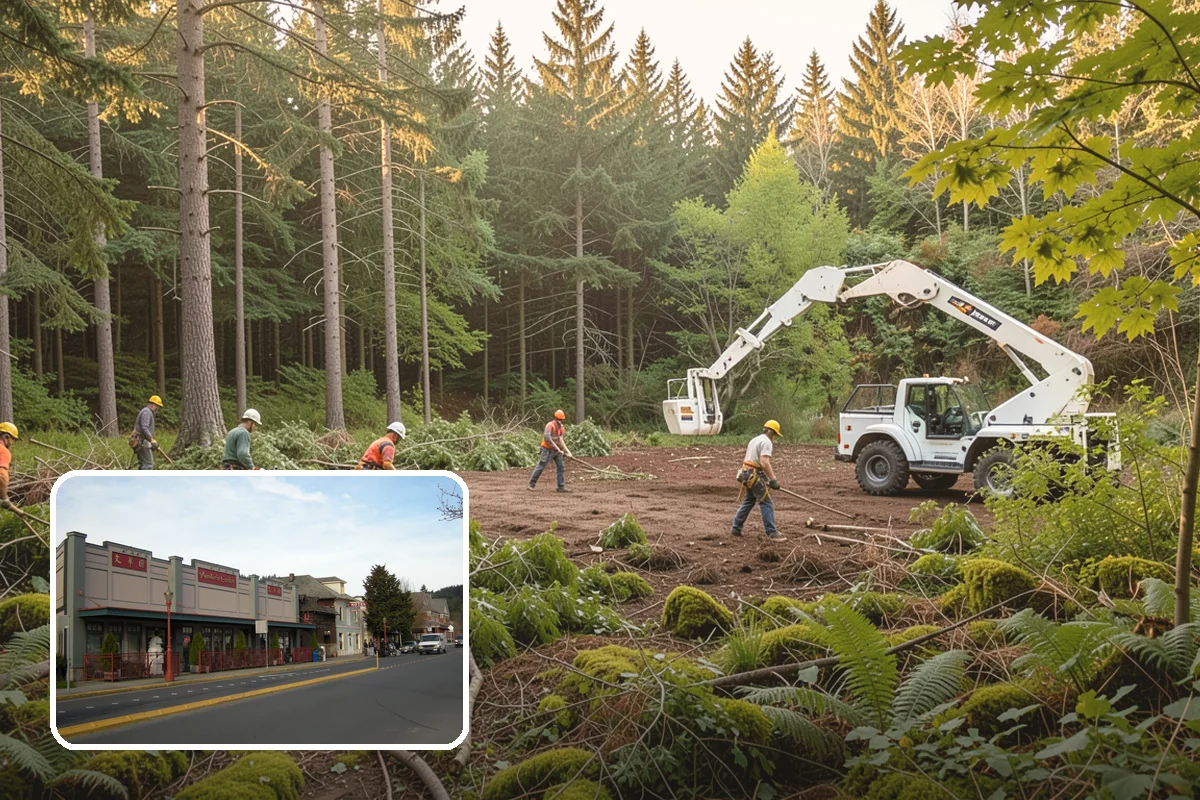
Choosing a clearing method for your Issaquah property
There is more than one way to clear underbrush. The right one depends on what is growing, how steep the ground is, and what you want the space to become.
Local conditions that shape the choice
A SILVIS Lab 2020 analysis puts about 93% of Issaquah's homes in the wildland-urban interface, where homes meet wildland vegetation. For an owner, that means the growth next to a house is often connected to larger stretches of vegetation, so how dense and continuous it is deserves attention. Satellite data shows about 41% of the city's land under dense tree cover, which suggests many lots sit under or beside heavy canopy where shade-loving brush thrives.
USGS elevation data shows Issaquah has a lot of steep ground compared with other Puget Sound cities. On a slope, roots of shrubs and groundcover help hold soil. That makes the choice of method matter more.
The main approaches
- Hand cutting with loppers, saws and string trimmers: best on steep or uneven ground, near trees you want to keep, and around young native plants worth saving. It is slower but selective.
- Brush cutter or mowing: suits flatter areas with dense, even growth such as blackberry thickets. It is faster, but it is less precise.
- Selective thinning rather than full clearing: removes dead material, invasive plants and crowded saplings while leaving a layer of healthy groundcover to protect soil.
On slopes, selective thinning is usually the more careful choice. Cutting stems at the surface and leaving roots in place keeps soil in place, and you can replant or let natives fill in afterward. Invasive plants like ivy and blackberry often regrow from roots, so follow-up trimming or removal may be needed.
Small trees are a separate question. Cutting brush is not the same as removing trees, and city tree rules may apply to removal. If the work might involve trees, we check with the city before it starts.
Call or text 425-484-4442 to set up a free estimate, and we can talk through which method fits your lot.
Issaquah tree conditions at a glance
| Homes in the wildland-urban interface | 93% |
|---|---|
| Land under dense tree cover (50%+ canopy) | 41% |
| Slopes | More steep ground than most Puget Sound cities |
| Landslides mapped by WA DNR | 39 |
| Rain and snow falling October to April | 81% of the year’s total |
Tree removal rules in Issaquah
A Tree Permit is required to remove significant trees; the only exemptions are removal of nonsignificant trees not otherwise protected, pruning that is not 'excessive', public agency/utility work in ROW/easements, and mineral extraction. Each removal must meet approval criteria in IMC 18.812.050 (e.g., nuisance trees, replacing dead significant trees, dying or diseased trees with qualified arborist recommendations).
Regulated size: 6 in.+ DBH, or alder/cottonwood 8 in.+ DBH, excluding King County Noxious Weed List species (per search-index text of city tree-code document.
Official city source. Rules change; we confirm with the city before work starts.
Tree health near Issaquah
- Decline, cause not identified7,786 ac
- Bears2,827 ac
- Heat1,132 ac
Forest damage mapped from the air within 10 km of Issaquah, 2021-2025 (USDA Forest Service and WA DNR). This covers forest land, not street or yard trees. “Decline, cause not identified” is dieback with no single cause found.
Sources: Daymet daily weather (NASA/ORNL), NOAA Storm Events, USDA plant hardiness map 2023, NRCS soil survey, USGS elevation, WA DNR landslide inventory, USDA Forest Service aerial survey, WSDA, city tree assessments and street-tree inventories, SILVIS Lab, Arbor Day Foundation, and official city and utility pages.
Underbrush Clearing Serving Issaquah
Issaquah


Underbrush clearing in nearby areas
Also serving Issaquah
- Land Grading in Issaquahat Washington Landscaping
- Garage Demolition in Issaquahat Washington Construction
- Bare Ground Vegetation Control in Issaquahat Washington City Services
- Log Splitting in Issaquahat Washington Firewood